Table of Contents
- Introduction
- What Is a Rummy Game?
- History of Rummy
- Why Rummy Is Popular Worldwide
- Different Types of Rummy Games
- Indian Rummy
- Gin Rummy
- Points Rummy
- Pool Rummy
- Deals Rummy
- Contract Rummy
- Canasta
- Basic Rules of Rummy
- Understanding Card Values
- Sets and Sequences Explained
- What Is a Pure Sequence?
- What Is an Impure Sequence?
- What Is a Set?
- How to Play Rummy Game Step-by-Step
- Important Rummy Terms Every Player Should Know
- Skills Required to Become a Better Rummy Player
- Beginner Tips for Winning at Rummy
- Common Mistakes to Avoid
- Advanced Winning Strategies
- Expert Card Management Techniques
- Online Rummy vs Offline Rummy
- Benefits of Playing Rummy
- How to Choose a Safe Online Rummy Platform
- Responsible Gaming Tips
- Conclusion
- Frequently Asked Questions (FAQs)
Introduction
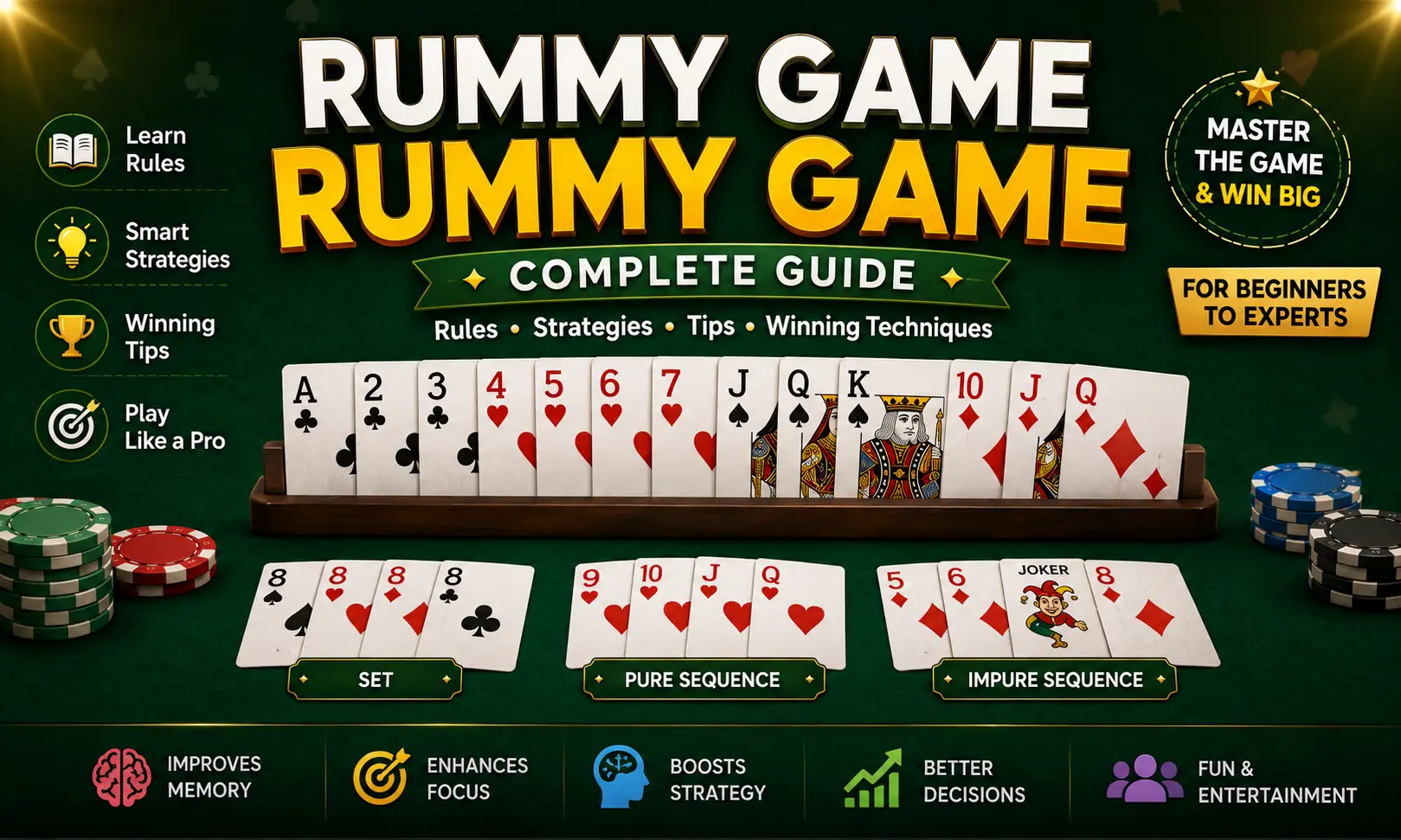
The Rummy Game Rummy Game experience has become one of the most popular card gaming activities across the world. Whether you play with family at home, compete with friends, or enjoy online tournaments, rummy continues to attract millions of players because it combines strategy, observation, memory, and decision-making.
Unlike games that depend purely on luck, rummy rewards players who think ahead, analyze opponents, and manage their cards wisely. Every move matters, from selecting the right card to discarding one that doesn’t help your hand.
Today, online rummy platforms have made the game even more accessible. Players can join cash games, practice matches, tournaments, and private tables from their smartphones or computers. With multiple variations available, every player can find a version that matches their skill level and interests.
This complete guide explains everything about Rummy Game Rummy Game, including its rules, gameplay, card values, strategies, and winning techniques. Whether you are a beginner learning the basics or an experienced player looking to sharpen your skills, this guide provides practical information to improve your game.
What Is a Rummy Game?
A rummy game is a card game where players create valid combinations known as sets and sequences. The objective is simple:
- Arrange all cards into valid groups.
- Form at least one pure sequence.
- Declare before your opponents.
- Score the fewest points.
Unlike many card games that rely heavily on luck, rummy encourages careful planning and strategic thinking.
Players must continuously observe:
- Their own cards
- Opponents’ discards
- Cards picked from the open pile
- Possible combinations
Every decision can influence the outcome of the game.
 Rummy
Rummy
Shiva Ji G| Jul 18, 2026| 18 min read
Rummy Noob: The Complete Beginner’s Guide to Learning Rummy (2026)
Why Is It Called a Skill-Based Game?
Several factors make rummy a game of skill:
Strategic Planning
Players must decide which cards to keep and which to discard.
Observation
Watching opponents helps identify the cards they may need.
Memory
Remembering discarded cards prevents unnecessary mistakes.
Probability
Experienced players estimate the chances of drawing useful cards.
Risk Management
Choosing whether to wait for a perfect card or create an alternative combination is an important skill.
Because of these elements, experienced players often perform consistently better than beginners.
History of Rummy
The exact origin of rummy remains debated among historians, but several theories exist.
Many researchers believe that modern rummy evolved from earlier matching-card games played in Europe during the nineteenth century.
Some experts trace its development to games like:
- Conquian
- Whiskey Poker
- Chinese Matching Games
Over time, rummy spread worldwide and evolved into numerous regional versions.
Today, popular variations include:
- Indian Rummy
- Gin Rummy
- Points Rummy
- Pool Rummy
- Deals Rummy
- Contract Rummy
- Canasta
- Oklahoma Rummy
Digital technology further transformed the game, allowing millions of players to compete online from anywhere.
Why Rummy Is Popular Worldwide
Several reasons explain the lasting popularity of rummy.
Easy to Learn
New players can understand the basic rules within minutes.
Challenging to Master
Although simple initially, advanced strategies require years of practice.
Social Entertainment
Families and friends enjoy playing together during festivals and gatherings.
Online Accessibility
Modern apps allow players to join games anytime.
Competitive Gameplay
Tournaments offer exciting competition against skilled players.
Strategic Depth
Every hand presents a unique challenge.
 Rummy
Rummy
Shiva Ji G| Jul 16, 2026| 16 min read
Top Rummy: The Ultimate Guide to the Best Online Rummy Platforms in 2026
Different Types of Rummy Games
The world of rummy offers many exciting variations.
1. Indian Rummy
Indian Rummy is among the most popular versions.
Features include:
- 13 cards per player
- Two decks
- Printed jokers
- One pure sequence required
- One additional sequence required
This version dominates online gaming platforms.
2. Gin Rummy
Gin Rummy usually involves:
- Two players
- One deck
- Faster gameplay
- Lower scores
The objective is to minimize unmatched cards.
3. Points Rummy
Each point carries monetary value.
Advantages include:
- Quick games
- Fast results
- Continuous action
Many experienced players prefer this format.
4. Pool Rummy
Players receive points after every game.
Those exceeding the maximum point limit are eliminated.
The last remaining player wins.
5. Deals Rummy
A fixed number of deals determines the winner.
The player with the lowest score after all deals wins.
6. Contract Rummy
Contract Rummy introduces changing objectives in every round.
Players complete different combinations before progressing.
7. Canasta
Canasta uses:
- Multiple decks
- Wild cards
- Team gameplay
- Large combinations
It remains extremely popular internationally.
Basic Rules of Rummy
Understanding the rules is essential before developing advanced strategies.
Number of Players
Usually:
- 2 players
- 3 players
- 4 players
- 6 players
Some formats allow even more participants.
Number of Cards
Most rummy games use:
- 13 cards
- Sometimes 10 cards depending on variation
Objective
Players must arrange cards into:
- Sets
- Sequences
A valid declaration requires at least one pure sequence.
Winning Condition
A player wins after:
- Creating valid combinations
- Making a successful declaration
- Having all cards arranged properly
Invalid declarations result in penalty points.
 Rummy
Rummy
Shiva Ji G| Jul 14, 2026| 16 min read
Rummy All Game: The Ultimate Guide to Every Rummy Variant in 2026
Understanding Card Values
Knowing card values helps calculate scores.
Number Cards
Cards from 2 to 10 carry face value.
Examples:
- 2 = 2 points
- 5 = 5 points
- 9 = 9 points
Face Cards
These include:
- Jack
- Queen
- King
Each equals:
10 points
Ace
Ace can act as:
- Lowest card
- Highest card
Depending on the sequence.
Examples:
A-2-3
or
Q-K-A
Joker
Jokers substitute missing cards.
However:
A pure sequence cannot contain a joker.
Understanding Sets and Sequences
This is the foundation of every rummy game.
What Is a Sequence?
A sequence consists of consecutive cards belonging to the same suit.
Example:
5♥ 6♥ 7♥
This is a valid pure sequence.
Pure Sequence
A pure sequence:
- Contains no joker
- Uses consecutive cards
- Same suit
Example:
8♠ 9♠ 10♠
Impure Sequence
An impure sequence contains a joker.
Example:
5♦ Joker 7♦
The joker replaces 6♦.
What Is a Set?
A set contains:
Same-ranked cards
Different suits
Examples:
7♠
7♦
7♣
Valid set.
How to Play Rummy Game Step-by-Step
Learning the complete flow helps beginners understand the game quickly.
Step 1
Cards are shuffled.
Step 2
Every player receives cards.
Step 3
One card becomes the open pile.
Remaining cards create the closed deck.
Step 4
Players take turns.
Each turn includes:
- Picking one card
- Discarding one card
Step 5
Players continue improving their combinations.
Step 6
When cards form valid combinations:
The player declares.
Step 7
Cards are verified.
If valid:
The player wins.
 Rummy
Rummy
Shiva Ji G| Jul 13, 2026| 17 min read
Rami Game: The Complete Beginner’s Guide to Rules, Strategy & Gameplay (2026)
Important Rummy Terms
Understanding common terminology makes learning easier.
Deck
Collection of playing cards.
Joker
Wild card replacing another card.
Open Deck
Discard pile visible to everyone.
Closed Deck
Face-down cards.
Meld
Creating sets and sequences.
Pure Sequence
Sequence without joker.
Impure Sequence
Sequence using joker.
Drop
Leaving the game before completion.
Middle Drop
Leaving after the game starts.
Declaration
Showing completed combinations.
Skills Required to Become a Good Rummy Player
Winning consistently requires several important skills.
Observation
Notice every discarded card.
Small details matter.
Memory
Remember which cards opponents ignored.
This improves decision-making.
Patience
Avoid rushing your declaration.
Wait for stronger combinations.
Strategic Thinking
Plan several moves ahead.
Never depend on one card only.
Decision Making
Sometimes discarding a useful card helps prevent helping your opponent.
Probability Analysis
Estimate remaining cards in the deck.
Professional players constantly calculate possibilities.
Beginner Tips for Better Gameplay
Every beginner can improve quickly using these practical tips.
Build a Pure Sequence First
This should always be your highest priority.
Without it, winning becomes impossible.
Use Jokers Wisely
Never waste jokers on combinations already complete.
Save them for difficult sequences.
Watch Opponents
Observe:
- Cards picked
- Cards discarded
These reveal their strategy.
Reduce High-Value Cards
Kings, Queens, and Jacks increase penalty points.
Discard unnecessary high cards early.
Avoid Holding Unmatched Cards
Unused cards increase your score if another player declares.
Rearrange Your Cards Frequently
Keeping cards organized improves planning.
Stay Focused
One careless discard can help an opponent complete their sequence.
Common Mistakes Beginners Make
Many new players repeat similar mistakes.
Avoiding these errors greatly improves your winning chances.
Ignoring Pure Sequence
This is the biggest mistake.
Always create it first.
Keeping Too Many High Cards
Face cards increase penalties.
Depending Only on Jokers
Jokers help—but cannot replace a pure sequence.
Declaring Too Early
Double-check every combination before declaring.
Invalid declarations lead to heavy penalties.
Helping Opponents
Avoid discarding cards opponents clearly need.
Watch their moves carefully.
Forgetting Discarded Cards
Experienced players remember important discards.
Memory becomes a major advantage.
Why Practice Makes Perfect
Like chess, poker, and other strategic games, rummy rewards experience.
The more you play, the better you become at:
- Reading opponents
- Calculating probabilities
- Creating combinations quickly
- Managing jokers efficiently
- Avoiding costly mistakes
- Improving decision-making under pressure
Consistent practice helps players develop instincts that cannot be learned from rules alone. By reviewing your games and applying better strategies over time, you can steadily improve your performance and confidence.
Advanced Winning Strategies for Rummy Game Rummy Game
Learning the rules is only the beginning. To consistently win a Rummy Game Rummy Game, players must develop advanced strategies that improve decision-making, reduce mistakes, and increase the chances of making a valid declaration before opponents.
1. Prioritize a Pure Sequence
The first objective in every game should always be forming a pure sequence. Since a valid declaration requires at least one pure sequence, delaying this step increases the risk of losing if another player declares early.
Tips:
- Focus on natural consecutive cards.
- Avoid using jokers in your first sequence.
- Build alternative sequence possibilities whenever possible.
2. Observe Opponents Carefully
Winning players pay close attention to every move their opponents make.
Watch for:
- Cards picked from the open pile
- Cards discarded repeatedly
- Cards avoided by other players
This information helps predict what combinations your opponents are building.
3. Discard High-Value Cards Early
Cards like:
- King
- Queen
- Jack
- Ace
carry high penalty points if they remain unmatched.
If these cards are not contributing to a sequence or set, discard them early to reduce your potential loss.
4. Use Jokers Strategically
Jokers are among the most valuable cards in any rummy game.
Instead of using them immediately:
- Save them for difficult combinations.
- Complete pure sequences naturally.
- Use jokers where replacing a missing card offers the highest benefit.
5. Keep Multiple Combination Options
Professional players rarely depend on a single combination.
For example:
Instead of waiting only for:
7♥
Keep possibilities like:
- 6♥ 7♥ 8♥
- 7♥ 8♥ 9♥
Having multiple options improves flexibility.
6. Rearrange Your Cards Frequently
As new cards arrive, reorganize your hand.
Grouping cards into:
- Possible sequences
- Possible sets
- High-risk cards
helps you make faster decisions.
7. Bluff Through Smart Discards
Sometimes discarding a useful-looking card can confuse opponents.
However, avoid unnecessary risks.
Bluffing works best after understanding your opponents’ playing style.
Expert Card Management Techniques
Good card management separates average players from experts.
Maintain Organized Groups
Arrange cards by:
- Suit
- Sequence possibilities
- Sets
- Jokers
This reduces mistakes during declaration.
Avoid Dead Cards
Dead cards have little chance of contributing to combinations.
Discard them quickly.
Calculate Remaining Cards
Estimate whether needed cards are:
- Already discarded
- Still in the deck
- Possibly held by opponents
Probability plays a major role in advanced gameplay.
Reduce Risk Continuously
Never allow your hand to become overloaded with unmatched cards.
Keep improving your combinations every turn.
Online Rummy vs Offline Rummy
Today, both online and traditional rummy remain popular.
| Feature | Online Rummy | Offline Rummy |
|---|---|---|
| Availability | 24/7 | Limited |
| Opponents | Global players | Friends & family |
| Practice | Unlimited | Occasional |
| Tournaments | Available | Rare |
| Speed | Fast | Moderate |
| Convenience | High | Medium |
| Skill Level | Mixed | Depends on players |
Both versions develop strategic thinking, but online platforms provide more opportunities to practice regularly.
Benefits of Playing Rummy
Many people enjoy rummy for more than entertainment.
Improves Memory
Players constantly remember:
- Discarded cards
- Opponent behavior
- Possible combinations
Enhances Concentration
Every move requires careful attention.
Missing one discard may cost the game.
Develops Strategic Thinking
Rummy encourages:
- Planning
- Analysis
- Prediction
- Adaptability
Better Decision Making
Players learn to:
- Evaluate risks
- Manage uncertainty
- Make faster decisions
Stress Relief
Playing casually with friends can provide relaxation after work.
Responsible gaming keeps the experience enjoyable.
How to Choose a Safe Online Rummy Platform
With many websites and mobile apps available, choosing a trustworthy platform is important.
Licensing
Choose platforms that operate legally in applicable jurisdictions.
Secure Payments
Reliable payment methods protect user transactions.
Fair Gameplay
Trusted platforms use certified Random Number Generators (RNGs) or equivalent fairness mechanisms where applicable.
Positive Reputation
Read user reviews and community feedback before registering.
Customer Support
Good support helps resolve account or payment issues quickly.
Responsible Gaming Features
Look for platforms offering:
- Deposit limits
- Self-exclusion options
- Time reminders
- Responsible gaming resources
Responsible Gaming
Rummy should always remain a form of entertainment.
Follow these healthy gaming practices:
- Set a budget before playing.
- Never chase losses.
- Take regular breaks.
- Avoid playing when tired or emotionally upset.
- Balance gaming with work, family, and personal responsibilities.
Playing responsibly ensures long-term enjoyment.
Conclusion
Rummy Game Rummy Game is much more than a traditional card game—it’s a strategic challenge that combines skill, patience, observation, and smart decision-making. Whether you’re a complete beginner learning the basics or an experienced player refining advanced techniques, mastering rummy requires consistent practice and a clear understanding of the game’s rules and strategies.
Throughout this guide, we’ve explored everything you need to know, from the fundamentals of creating valid sets and sequences to advanced winning strategies, card management techniques, common mistakes to avoid, and responsible gaming practices. By focusing on building a pure sequence first, using jokers wisely, observing your opponents’ moves, and making calculated decisions, you can significantly improve your chances of success in every match.
One of the biggest advantages of rummy is that it rewards skill over time. While every game starts with a random deal of cards, experienced players consistently perform better because they understand probability, maintain discipline, and adapt their strategies to different situations. Regular practice not only enhances your gameplay but also strengthens valuable cognitive skills such as memory, concentration, logical thinking, and decision-making.
If you choose to play online, always select a trusted and secure platform that offers fair gameplay, transparent policies, and responsible gaming tools. Remember to set personal limits, play within your budget, and treat rummy as a source of entertainment rather than a way to earn money. Responsible gaming ensures that the experience remains enjoyable and stress-free.
As the popularity of online card games continues to grow, Rummy Game Rummy Game remains one of the most exciting and rewarding options for players worldwide. With the right knowledge, regular practice, and a strategic mindset, you can confidently improve your skills and enjoy every game.
Start applying the strategies shared in this guide, keep learning from every match, and most importantly, enjoy the timeless excitement of the classic rummy card game. Good luck, play responsibly, and may your next declaration be a winning one!
Frequently Asked Questions (FAQs) About Rummy Game Rummy Game
A Rummy Game is a popular skill-based card game where players aim to arrange the cards dealt to them into valid sets and sequences. The primary objective is to make at least one pure sequence (a sequence without a joker) and then organize all remaining cards into valid combinations before your opponents do. Most versions of rummy, including Indian Rummy, are played with 13 cards using one or two standard decks of cards, depending on the game format.
Gameplay begins with each player receiving a fixed number of cards. During every turn, a player picks one card either from the closed deck or the open discard pile and then discards one unwanted card. This process continues until a player successfully arranges all cards into valid combinations and makes a declaration. The declaration is then verified according to the game rules. If it is valid, the player wins the game. Since every move requires planning and observation, rummy is considered a game that rewards skill, strategy, and experience rather than relying solely on luck.
Rummy is widely recognized as a skill-based card game because long-term success depends on a player’s ability to make smart decisions rather than on the initial cards they receive. While luck plays a small role in determining the cards dealt at the beginning of each game, experienced players consistently outperform beginners by using effective strategies.
Successful rummy players carefully observe the cards their opponents pick and discard, remember previously discarded cards, calculate probabilities, and make informed decisions throughout the game. They also know when to hold valuable cards, when to discard high-point cards, and how to use jokers effectively. These strategic elements make rummy very different from games that rely entirely on chance. Regular practice helps improve memory, concentration, analytical thinking, and decision-making, allowing players to become more consistent over time. For this reason, many players enjoy rummy not only for entertainment but also as a mentally engaging card game.
Understanding the difference between a pure sequence and an impure sequence is essential for every rummy player because a valid declaration is impossible without at least one pure sequence. A pure sequence is formed by arranging three or more consecutive cards of the same suit without using any joker or wild card. For example, 5♥, 6♥, and 7♥ form a valid pure sequence because all cards are consecutive and belong to the same suit.
An impure sequence, on the other hand, includes a joker that substitutes for one of the missing cards in a consecutive sequence. For instance, 8♣, Joker, and 10♣ can be considered an impure sequence if the joker represents the 9♣. While impure sequences are perfectly valid in most rummy formats, they cannot replace the mandatory pure sequence required for a successful declaration. Beginners are advised to focus on building a pure sequence as early as possible before working on sets and impure sequences. This approach reduces the risk of invalid declarations and significantly improves the chances of winning.
Improving your performance in rummy requires consistent practice and a strategic approach. One of the most important strategies is to create a pure sequence immediately after receiving your cards. Since every valid declaration depends on it, delaying this objective can be risky. Players should also discard unnecessary high-value cards like Kings, Queens, Jacks, and Aces if they are not contributing to useful combinations, as these cards carry higher penalty points if another player declares first.
Another effective strategy is to observe your opponents closely. Watching which cards they pick from the discard pile and which cards they avoid can reveal the combinations they are trying to build. Additionally, jokers should be used wisely to complete difficult sequences or sets rather than being wasted on combinations that can be formed naturally. Rearranging your cards frequently helps you identify better opportunities and avoid confusion during the game. Finally, avoid making hurried declarations. Always double-check every set and sequence before declaring, because an invalid declaration results in significant penalty points. With patience, observation, and regular practice, players gradually develop stronger decision-making skills that lead to more consistent victories.
Online rummy can be an enjoyable and convenient way to play, provided you choose a reputable platform and follow responsible gaming practices. Before creating an account, players should ensure that the platform has a good reputation, secure payment methods, transparent terms and conditions, responsive customer support, and responsible gaming features such as deposit limits or self-exclusion options where available. Reading user reviews and understanding the platform’s policies can help you make an informed decision.
Equally important is maintaining responsible gaming habits. Players should always set a budget before playing and avoid spending more than they can comfortably afford to lose. It’s also a good idea to take regular breaks, avoid chasing losses, and remember that rummy should be treated as a form of entertainment rather than a guaranteed source of income. Practicing with free games before participating in competitive matches can help beginners improve their skills without financial pressure. By combining smart gameplay with responsible habits, players can enjoy the excitement of online rummy while keeping the experience safe, balanced, and enjoyable.
Leave a Reply