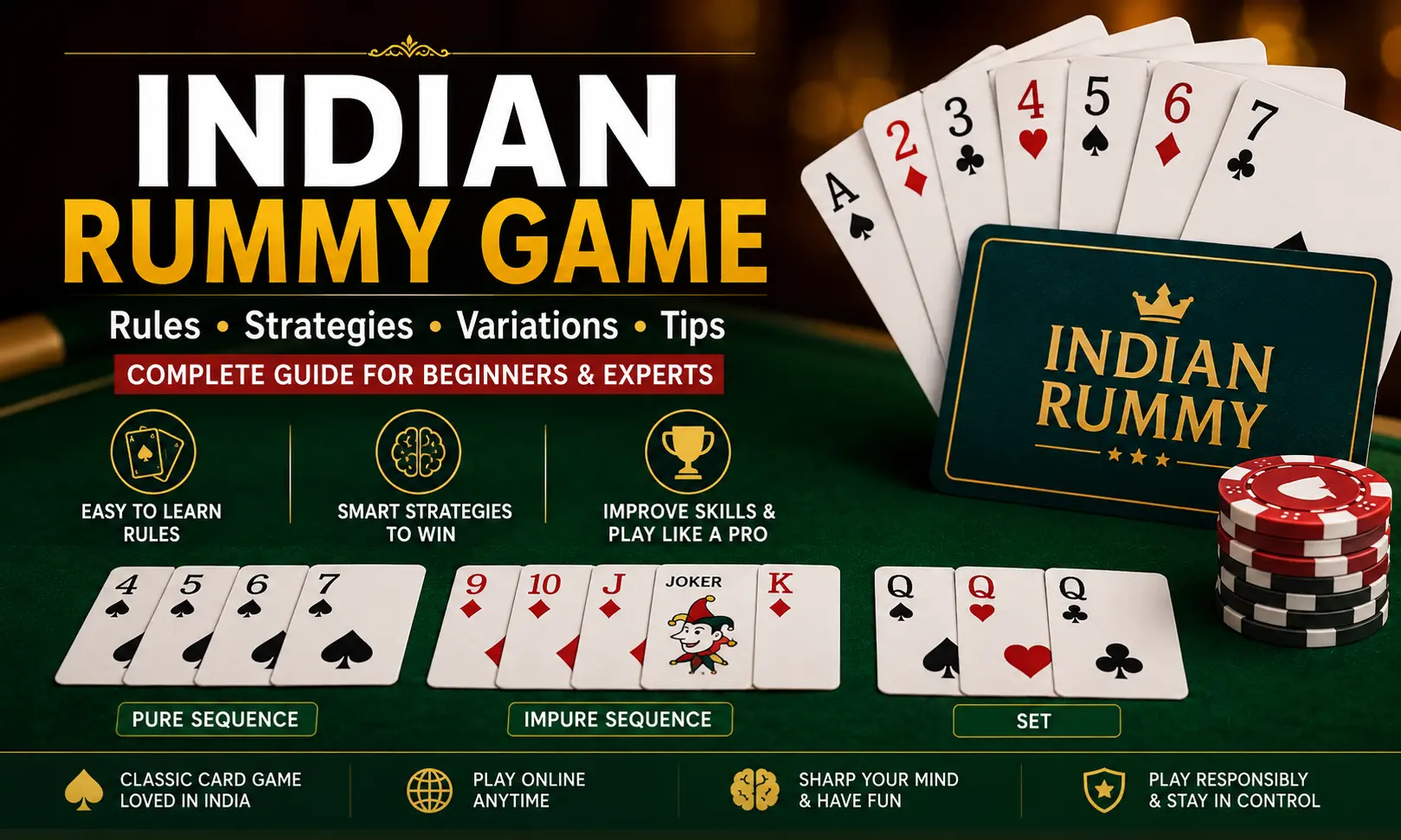
Indian rummy is one of the most popular traditional card games in India. Over the years, it has evolved from a social card game played with friends and family into a widely played online format accessible through smartphones, tablets, and computers. The Indian rummy game combines memory, observation, probability, decision-making, and strategic planning, making it more than a simple game of luck.
Whether you are completely new to rummy or already understand the basic rules, learning how the game works can significantly improve your decision-making at the table. This guide explains the fundamentals of Indian rummy, popular variations, card sequences, sets, winning conditions, practical strategies, common mistakes, online gameplay considerations, and responsible gaming practices.
Important: Online rummy platforms can involve real-money play. Availability, legality, age requirements, taxation, and platform rules can vary by Indian state and can change over time. Always check the current laws and the terms of the platform you use. Play only where permitted and only with money you can afford to lose.
Table of Contents
- What Is an Indian Rummy Game?
- Why Is Indian Rummy So Popular?
- How Indian Rummy Works
- Understanding the Rummy Deck
- Objective of Indian Rummy
- What Is a Sequence in Indian Rummy?
- Pure Sequence Explained
- Impure Sequence Explained
- What Is a Set?
- Basic Indian Rummy Rules
- How to Play Indian Rummy Step by Step
- Popular Indian Rummy Variations
- Points Rummy
- Pool Rummy
- Deals Rummy
- Indian Rummy Game Strategies
- How to Build a Pure Sequence Quickly
- How to Reduce Deadwood Cards
- Card Observation Techniques
- Discarding Strategy
- Understanding Opponents’ Cards
- Advanced Indian Rummy Strategies
- Common Mistakes Beginners Make
- Indian Rummy Game Online
- Choosing an Online Rummy Platform
- Account and Gameplay Safety
- Responsible Gaming
- Final Thoughts
- Conclusion
- Frequently Asked Questions
What Is an Indian Rummy Game?
An Indian rummy game is a skill-based card game traditionally played with one or more standard decks of cards, depending on the number of participants and the particular rummy variation.
The most common format is based on arranging cards into sequences and sets. Players draw one card and discard one card during each turn while attempting to organize their hand into valid combinations.
The central challenge is simple to understand but difficult to master:
Draw useful cards, discard unnecessary cards, observe what opponents need, and arrange your hand into valid combinations before they do.
Indian rummy generally requires players to make combinations such as:
- Pure sequences
- Impure sequences
- Sets
- Additional valid sequences
The exact winning requirement can differ depending on the specific format being played.
Why Is It Considered a Skill Game?
Teen Patti Master APK
Although the cards you receive are random, your decisions after receiving them are not.
Players have to decide:
- Which cards should be retained?
- Which cards should be discarded?
- Which sequence should be completed first?
- Is a high-value card becoming dangerous?
- What cards might an opponent be collecting?
- Should you take a card from the open pile?
- When should you change your strategy?
These decisions make Indian rummy a game of strategic judgment.
 Rummy
Rummy
SH Shiva Ji G| Jul 24, 2026| 17 min read
Rummynabob: The Complete Guide to Rules, Gameplay, Strategies, and Winning Tips (2026)
Why Is Indian Rummy So Popular?
The popularity of Indian rummy comes from its combination of simplicity and depth.
A beginner can learn the basic rules relatively quickly. However, becoming consistently good requires practice, observation, probability awareness, and disciplined decision-making.
1. Easy to Understand
The basic gameplay follows a straightforward cycle:
Draw → Arrange → Analyze → Discard
Because the core mechanism is simple, beginners can start learning without mastering complicated rules first.
2. Strong Strategic Element
Every card can influence your future possibilities. A seemingly useless card might become valuable after drawing the right card.
Consequently, good players continuously reassess their hands rather than following one fixed plan.
3. Different Game Formats
Indian rummy can be played in several formats, including:
- Points Rummy
- Pool Rummy
- Deals Rummy
- Practice games
- Tournaments, depending on the platform
Each format creates slightly different strategic considerations.
4. Social Entertainment
Traditional rummy has long been associated with family gatherings and friendly card sessions. Online versions have made it easier for players to participate from different locations.
How Indian Rummy Works
Before discussing advanced techniques, beginners should understand the basic structure of a typical game.
A standard turn generally involves two actions:
- Drawing one card
- Discarding one card
During the game, players gradually transform an unorganized hand into valid combinations.
For example, suppose a player has:
5♥ 6♥ 7♥
These cards form a sequence because they are consecutive cards of the same suit.
Similarly:
Q♣ Q♦ Q♥
forms a set because the cards have the same rank but different suits.
The ultimate objective is to arrange the complete hand according to the rules of the particular Indian rummy variation.
Understanding the Rummy Deck
Indian rummy commonly uses standard playing cards.
A standard deck contains four suits:
- Hearts ♥
- Diamonds ♦
- Clubs ♣
- Spades ♠
Each suit contains:
- Ace
- 2 through 10
- Jack
- Queen
- King
Depending on the number of players and game format, one or more decks may be used.
Card Values
In points-based scoring systems, numbered cards generally carry their face value, while face cards typically have higher fixed values.
Commonly:
- Ace = 10 points
- Jack = 10 points
- Queen = 10 points
- King = 10 points
- 10 = 10 points
- Number cards = their printed value
However, exact scoring rules can vary between formats and platforms.
 Rummy
Rummy
SH Shiva Ji G| Jul 21, 2026| 18 min read
Rummy Game Rummy Game: The Complete Beginner to Expert Guide for Winning, Rules, Strategies, and Online Play
Objective of Indian Rummy
The primary goal is to organize your cards into valid combinations.
A typical 13-card Indian rummy hand requires valid sequences and sets, with at least one pure sequence being an essential requirement in many common formats.
A simplified example might look like this:
Pure Sequence
4♠ 5♠ 6♠
Second Sequence
9♥ 10♥ J♥
Set
K♣ K♦ K♠
Additional Combination
2♣ 3♣ 4♣
The exact arrangement and declaration requirements depend on the rules of the specific game.
What Is a Sequence in Indian Rummy?
A sequence consists of three or more consecutive cards belonging to the same suit.
For example:
7♣ 8♣ 9♣
is a valid sequence.
Another example:
10♦ J♦ Q♦ K♦
is also a valid sequence.
Sequences are among the most important combinations in Indian rummy because they form the foundation of a valid declaration.
Pure Sequence Explained
A pure sequence is a sequence made entirely from natural cards, without using a joker as a substitute.
For example:
3♥ 4♥ 5♥
is a pure sequence.
Another example:
8♠ 9♠ 10♠ J♠
is also a pure sequence.
Why Is a Pure Sequence Important?
In many common Indian rummy formats, a valid declaration must contain at least one pure sequence.
Therefore, beginners should usually prioritize creating a pure sequence early in the game.
A player might have an otherwise excellent hand, but without the required pure sequence, the hand may not qualify as a valid declaration.
Impure Sequence Explained
An impure sequence contains a joker substituting for a missing card.
For example:
5♦ 6♦ Joker 8♦
can represent:
5♦ 6♦ 7♦ 8♦
if the joker is being used as the 7♦.
An impure sequence can be extremely useful because jokers provide flexibility.
However, players should remember that an impure sequence generally does not replace the requirement for a pure sequence where the rules require one.
What Is a Set?
A set consists of three or four cards of the same rank but different suits.
For example:
8♣ 8♦ 8♥
forms a valid set.
Another example:
Q♣ Q♦ Q♥ Q♠
forms a four-card set.
Set vs Sequence
| Combination | Requirement | Example |
|---|---|---|
| Pure Sequence | Consecutive cards, same suit, no joker | 4♥ 5♥ 6♥ |
| Impure Sequence | Consecutive cards with joker substitution | 4♥ 5♥ Joker |
| Set | Same rank, different suits | 9♣ 9♦ 9♥ |
Understanding this distinction is essential for every Indian rummy player.
 Rummy
Rummy
SH Shiva Ji G| Jul 18, 2026| 18 min read
Rummy Noob: The Complete Beginner’s Guide to Learning Rummy (2026)
Basic Indian Rummy Rules
Although specific rules can differ, the basic gameplay generally follows these principles.
Rule 1: Draw One Card
At the beginning of your turn, you select one card from an available pile.
Rule 2: Arrange Your Cards
After drawing, evaluate how the new card affects your possible combinations.
Rule 3: Discard One Card
You normally end your turn by placing one unwanted card in the discard pile.
Rule 4: Create Valid Combinations
Your objective is to organize your cards into sequences and sets.
Rule 5: Follow Declaration Requirements
When your hand is complete, you declare according to the particular format.
A declaration may be invalid if the hand does not contain the required combinations.
How to Play Indian Rummy Step by Step
Step 1: Study Your Initial Hand
Do not immediately decide which cards to discard.
Instead, examine your complete hand.
Look for:
- Existing sequences
- Potential sequences
- Pairs
- Sets
- Jokers
- High-value unmatched cards
This first assessment gives you a strategic starting point.
Step 2: Identify Your Strongest Combination
If you already have a pure sequence, preserve it unless there is an exceptionally strong reason to change your structure.
If you do not have one, search for cards that can help build one.
Step 3: Separate Useful and Uncertain Cards
Group your hand mentally.
For example:
Possible Sequence: 6♣ 7♣
Possible Set: Q♥ Q♠
Unmatched: K♦
This makes your decision-making easier.
Step 4: Draw Carefully
After drawing a card, ask:
Does this card improve my hand?
If yes, keep it.
If not, consider whether it could have strategic value or whether discarding it is safer.
Step 5: Watch the Discard Pile
The cards opponents discard provide valuable information.
If someone repeatedly discards cards from one suit, they may not be interested in that suit.
However, avoid assuming that one discard reveals an entire strategy.
Step 6: Reduce Unnecessary Points
Unmatched high-value cards can become dangerous if another player declares first.
Therefore, if a King, Queen, Jack, or 10 has no realistic combination potential, consider releasing it.
Step 7: Declare Only When Valid
Before declaring, check your combinations carefully.
A final review can prevent avoidable declaration errors.
Popular Indian Rummy Variations
Indian rummy is not limited to one format.
The three major formats commonly associated with online Indian rummy are:
- Points Rummy
- Pool Rummy
- Deals Rummy
Let’s examine each one.
Points Rummy
Points Rummy is generally designed for relatively quick rounds.
Cards have assigned point values, and the winner’s result is calculated according to the game’s scoring system.
Why Players Like Points Rummy
- Fast gameplay
- Simple scoring
- Short rounds
- Strategic decision-making
- Easy-to-understand structure
Because rounds can be relatively short, players need to make decisions efficiently.
Pool Rummy
Pool Rummy usually involves players accumulating points during multiple rounds.
Common formats include different target-point structures depending on the platform.
The objective is generally to remain below a predetermined point limit or avoid elimination.
Strategic Difference
Pool Rummy places greater emphasis on long-term risk management.
A player should not focus exclusively on winning one round. Managing losses can be equally important.
Deals Rummy
Deals Rummy typically provides players with chips or points at the beginning of a match.
Players compete across a predetermined number of deals.
At the end, the player with the strongest overall position wins according to the format’s scoring system.
Strategic Consideration
Consistency becomes particularly important because every deal contributes to the final result.
Indian Rummy Game Strategies
Learning the rules is only the beginning.
Good strategy involves making better decisions with imperfect information.
1. Prioritize a Pure Sequence
One of the most important principles is to work toward a pure sequence early.
Suppose you receive:
4♥ 5♥ 8♥ 9♥
You might initially focus on the 4♥ and 5♥ combination while evaluating whether another heart can complete the sequence.
However, do not blindly keep every card from the same suit.
The cards must have realistic connectivity.
 Rummy
Rummy
SH Shiva Ji G| Jul 16, 2026| 16 min read
Top Rummy: The Ultimate Guide to the Best Online Rummy Platforms in 2026
How to Build a Pure Sequence Quickly
Look for connected cards.
For example:
7♠ 8♠
has immediate sequence potential because either a 6♠ or 9♠ could improve the combination.
By contrast:
3♠ 9♠
has significantly weaker immediate potential.
Practical Principle
Connected cards generally have greater immediate combination potential than widely separated cards.
However, probability is not certainty. A player should continually reassess the hand as new cards arrive.
2. Reduce Deadwood Cards
Deadwood refers to cards that are not contributing meaningfully to your combinations.
For example, suppose your hand contains:
K♦, 2♣, 9♠
and none of these cards connects with your other combinations.
Holding all three indefinitely may increase your potential point loss.
Therefore, identify cards that have little realistic chance of becoming useful.
3. Be Careful With High-Value Cards
High-value cards can be useful when they form sequences or sets.
For example:
J♥ Q♥ K♥
is an excellent sequence.
However:
K♣
standing alone can be risky.
The key is not to automatically discard every high card. Instead, evaluate its combination potential.
4. Observe Opponent Discards
The discard pile is a source of information.
Suppose another player repeatedly discards:
- 2♣
- 5♣
- 9♣
This could suggest they are not building a Clubs-heavy hand.
However, do not treat this as definite evidence. Players can change their strategy.
Observation should influence your decisions, not completely determine them.
5. Avoid Helping Your Opponent
One of the most important tactical skills is deciding what not to discard.
Suppose your opponent picks up:
7♥
from the discard pile.
Later, you receive:
8♥
You should think carefully before discarding the 8♥.
Your opponent may already be building a heart sequence.
There is no guarantee that they need it, but the possibility deserves consideration.
Advanced Indian Rummy Game Strategies
Once you understand the basics, you can begin using more sophisticated techniques.
Card Tracking
Experienced players mentally track important cards.
For example, if you need:
9♣
and have already seen multiple 9s, the probability of obtaining the exact card may become lower.
You should therefore maintain alternative combinations.
Why Flexibility Matters
A rigid strategy can fail when the required card does not appear.
Instead of waiting indefinitely for one card, build multiple potential paths.
Flexible Hand Construction
Suppose you have:
5♦ 6♦
and:
5♠ 5♥
You have two potential directions.
You could attempt:
4♦ 5♦ 6♦
or:
5♠ 5♥ 5♣
This flexibility is valuable.
Rather than deciding immediately, wait for additional information.
The Two-Sequence Principle
A practical approach is to develop more than one sequence possibility before focusing heavily on sets.
For example:
3♣ 4♣
and
9♥ 10♥
give you two sequence-building opportunities.
If one does not develop, the other may still work.
Strategic Use of Jokers
Jokers are powerful because they can substitute for missing cards in eligible combinations.
However, using a joker correctly is more important than simply possessing one.
Suppose you have:
6♣ 7♣ Joker
You can potentially use the joker as 8♣.
But if you also have:
9♦ 10♦ Joker
you need to decide which combination benefits more from the joker.
General Principle
Use flexible cards where they provide the greatest improvement to your overall hand.
Middle Cards Can Be Flexible
Cards around the middle of the sequence range can often connect in multiple ways.
For example, a 7 can potentially connect with:
5-6-7
or
7-8-9
This gives it more immediate sequence possibilities than an isolated extreme card.
However, suit still matters.
Common Mistakes Beginners Make
Even after understanding the rules, beginners frequently make avoidable mistakes.
Mistake 1: Holding High Cards Too Long
A player may keep a King simply because it might become useful.
If it remains unmatched for several turns, it can become a liability.
Better Approach
Set a mental deadline.
If a card does not develop into a useful combination after several turns, reconsider it.
Mistake 2: Chasing One Card
Suppose you need 8♦ to complete a sequence.
Waiting turn after turn can be dangerous.
Better Approach
Create alternative combinations while waiting.
Mistake 3: Ignoring the Discard Pile
Some beginners focus only on their own cards.
That wastes valuable information.
The discard pile can provide clues about opponents’ possible combinations.
Mistake 4: Declaring Too Quickly
Excitement can cause players to declare without checking every group.
Before declaring, verify:
- Pure sequence
- Additional sequence
- Sets
- Joker usage
- Number of cards
- Required combination structure
Mistake 5: Assuming Every Pair Is Valuable
Two cards of the same rank do not automatically make a strong combination.
For example:
Q♥ Q♠
needs another Queen of a different suit to become a set.
Until then, the pair should be evaluated according to the rest of your hand.
Indian Rummy Game Online
The online version of Indian rummy has changed how people access the game.
Instead of needing a physical deck and a group of players in the same room, users can often play through a digital interface.
Online platforms may offer:
- Practice tables
- Different rummy formats
- Tournaments
- Leaderboards
- Multiplayer rooms
- Mobile applications
- Digital account management
However, the quality and legitimacy of platforms can differ significantly.
How to Choose an Online Indian Rummy Platform
If you decide to play Indian rummy online, do not choose a platform based only on promotional offers.
Consider the following factors.
1. Legal Availability
Check whether the platform is permitted to operate in your location and whether the particular game format is legally available to you.
Indian regulations can vary between jurisdictions.
2. Age Requirements
Use platforms only if you meet the applicable minimum age requirement.
3. Clear Terms
Read the:
- Terms and conditions
- Withdrawal policies
- Bonus conditions
- Privacy policy
- Responsible gaming information
4. Account Security
Choose services that provide appropriate account protection and avoid sharing passwords or one-time authentication codes.
5. Transparent Support
A reputable service should provide clear ways to contact customer support.
Indian Rummy Game on Mobile Devices
Mobile gaming has made rummy highly accessible.
A modern smartphone can generally handle the graphical requirements of card-game applications easily.
When using a mobile rummy platform, consider:
- Downloading apps only from trusted sources
- Checking developer information
- Reviewing requested permissions
- Keeping your operating system updated
- Using strong account credentials
- Avoiding unknown APK files
Why Unknown APKs Can Be Risky
Installing applications from unofficial websites can expose users to:
- Malware
- Data theft
- Fake applications
- Unauthorized account access
- Financial scams
Therefore, convenience should never take priority over digital security.
Responsible Gaming
Responsible gaming should be part of any discussion about real-money card games.
Even when a game involves substantial skill, outcomes are not guaranteed.
A strong player can still lose because of:
- Unfavorable cards
- Unexpected opponent decisions
- Miscalculations
- Variance
- Mistakes
Therefore, players should establish limits before playing.
Set a Budget
Never use money required for:
- Rent
- Food
- Education
- Bills
- Emergency expenses
- Essential family needs
Treat any money used for entertainment as money that could be lost.
Set Time Limits
Long gaming sessions can lead to poor decision-making.
Take regular breaks and avoid playing when tired, angry, or emotionally frustrated.
Never Chase Losses
One of the most dangerous habits is increasing spending to recover previous losses.
A losing session does not guarantee that the next session will be profitable.
Indian Rummy Game: Skill vs Luck
This is one of the most frequently discussed topics surrounding rummy.
The cards you receive are random, which introduces an element of uncertainty.
However, decisions made after receiving those cards involve skill.
Players must determine:
- What to keep
- What to discard
- What combinations to pursue
- How to interpret opponent behavior
- When to change strategies
Therefore, the outcome of a particular hand should not be confused with guaranteed results.
Skill can improve decision quality, but it cannot guarantee a win in every round.
How Beginners Can Improve at Indian Rummy
Improvement usually comes from deliberate practice rather than simply playing more games.
Practice 1: Analyze Your Opening Hand
Before drawing, identify:
- Existing sequences
- Potential sequences
- Pairs
- High cards
- Jokers
Practice 2: Review Your Discards
After each game, ask:
Did I discard any card too early?
and:
Did I hold any useless card too long?
Practice 3: Watch Opponents
Instead of focusing entirely on your own hand, pay attention to:
- Cards they pick
- Cards they discard
- Suits they appear to avoid
- Combinations they may be developing
Practice 4: Learn From Mistakes
Keep track of recurring mistakes.
For example:
Mistake: Holding high-value unmatched cards.
Correction: Evaluate their potential earlier.
Expert-Level Decision Making
Advanced Indian rummy is less about finding a single “winning trick” and more about managing possibilities.
Think in Probabilities
Instead of asking:
Will I get this card?
Ask:
How many useful cards could improve this combination?
A hand with several possible improvements is often more flexible than one dependent on a single exact card.
Manage Risk and Reward
Suppose you can keep a high-value card because it might complete a sequence.
The potential reward is useful.
But the risk is that the card remains unmatched.
Good players constantly balance both possibilities.
Adapt Your Strategy
Your opening strategy should not remain fixed throughout the entire game.
Cards appearing in the draw and discard piles can change your priorities.
A strong player recognizes when a plan is failing and switches to a more realistic combination structure.
Indian Rummy Game Tips at a Glance
Here are practical tips you can remember during gameplay:
- Build a pure sequence early.
- Do not hold useless high cards unnecessarily.
- Watch the discard pile.
- Track important cards.
- Keep your combinations flexible.
- Use jokers strategically.
- Avoid chasing one specific card for too long.
- Think about what your opponents might need.
- Check your hand carefully before declaring.
- Practice decision-making rather than relying on luck.
- Set a personal gaming budget.
- Never chase losses.
Final Thoughts
The Indian rummy game is a fascinating combination of traditional card-game culture and modern strategic gameplay. Its basic rules are accessible to beginners, while its deeper mechanics provide plenty of room for experienced players to improve.
The most important lesson is that success should not be measured by one lucky hand. Strong rummy play comes from making sensible decisions repeatedly: building useful combinations, creating a pure sequence, managing high-value cards, observing opponents, using jokers effectively, and adapting when the cards do not develop as expected.
For beginners, the best starting point is to learn the rules thoroughly and practice without focusing on financial outcomes. For experienced players, improving observation, probability awareness, hand flexibility, and risk management can make gameplay more disciplined.
Finally, anyone playing online should prioritize security, understand the rules and legal requirements applicable to their location, and practice responsible gaming. No rummy strategy can guarantee winnings, so the game should always be approached as entertainment rather than a guaranteed source of income.
Conclusion
The Indian rummy game is a classic card game that combines simple rules with meaningful strategic depth. Whether you are a complete beginner learning how sequences and sets work or an experienced player looking to improve your decision-making, understanding the fundamentals is the first step toward becoming a more disciplined player.
The key to playing Indian rummy effectively is not simply waiting for favorable cards. Instead, players should learn how to organize their hands, build a pure sequence, identify useful combinations, manage high-value cards, use jokers wisely, and observe the cards being picked and discarded by opponents. At the same time, flexibility is essential because a strategy that looks promising at the beginning of a round may need to change as new cards appear.
Different formats, including Points Rummy, Pool Rummy, and Deals Rummy, also offer different styles of gameplay. Learning the rules and scoring system of each format can help players make better decisions and avoid unnecessary mistakes.
For anyone interested in playing an Indian rummy game online, safety should be just as important as strategy. Always use legitimate platforms where the game is legally available, read the terms and conditions carefully, protect your account information, and understand the applicable age, financial, and regional requirements. Most importantly, remember that even skilled players cannot guarantee a win in every round.
Ultimately, Indian rummy is best enjoyed as a strategic form of entertainment. Learn the rules, practice patiently, analyze your decisions, and play responsibly. With consistent practice and a thoughtful approach, you can develop a much stronger understanding of this popular card game while keeping your gameplay enjoyable and controlled.
Frequently Asked Questions About Indian Rummy Game
An Indian rummy game is a popular card game based on arranging cards into valid combinations called sequences and sets. Players usually receive a fixed number of cards and take turns drawing one card and discarding another. The objective is to organize the entire hand into valid combinations and make a correct declaration according to the rules of the selected rummy format.
A sequence consists of consecutive cards from the same suit. For example, 4♥, 5♥, and 6♥ form a valid sequence. A pure sequence does not use a joker as a substitute, while an impure sequence may use a joker. A set, on the other hand, contains cards of the same rank from different suits, such as 8♠, 8♥, and 8♦.
For beginners, the most important concept to understand is the pure sequence. Many standard Indian rummy formats require at least one pure sequence before a player can make a valid declaration. Learning how to identify these combinations quickly can make the game easier to understand.
The game also involves observation and decision-making. Players must decide which cards to keep, which cards to discard, and which combinations are most realistic to complete. Consequently, Indian rummy is not simply about receiving good cards; it also involves using the available cards effectively.
A pure sequence is one of the most important combinations in an Indian rummy game. It consists of at least three consecutive cards belonging to the same suit, without using a joker as a substitute.
For example, 6♣, 7♣, and 8♣ form a pure sequence. Similarly, 10♦, J♦, Q♦, and K♦ can form a longer pure sequence.
Understanding the difference between a pure and impure sequence is essential. An impure sequence uses a joker to represent a missing card. For instance, 5♠, 6♠, Joker, and 8♠ can represent a sequence when the joker substitutes for 7♠ under the applicable rules.
A pure sequence is particularly important because many common Indian rummy variations require players to have at least one pure sequence for a valid declaration. Therefore, beginners should generally pay attention to building a pure sequence early rather than concentrating only on sets.
However, players should not become so focused on one possible sequence that they ignore the rest of their hand. If a particular combination becomes unlikely, it may be better to adapt and develop another sequence.
There is no guaranteed strategy that can win every Indian rummy game. However, several practical techniques can improve decision-making and help players manage their hands more effectively.
First, try to create a pure sequence early. Next, identify cards that can potentially form additional sequences or sets. Connected cards are often more useful than isolated cards because they may have multiple combination possibilities.
Another important strategy is to avoid keeping unnecessary high-value cards for too long. Cards such as Kings, Queens, Jacks, and 10s can contribute significant points if they remain unmatched. If they do not appear to have a realistic combination opportunity, consider discarding them.
Players should also observe the discard pile carefully. The cards opponents pick and discard can provide clues about the combinations they may be attempting to build. Nevertheless, these clues should be treated as information rather than certainty because opponents can change their strategy.
Jokers should also be used thoughtfully. A joker can complete an important combination, but the best use depends on the overall structure of your hand.
Finally, avoid depending on one specific missing card. Building alternative combinations gives you greater flexibility when the desired card does not appear.
There are several popular variations of Indian rummy, and each has its own scoring structure and gameplay characteristics. The three formats commonly associated with online Indian rummy are Points Rummy, Pool Rummy, and Deals Rummy.
Points Rummy is generally designed for relatively quick rounds. Cards have assigned point values, and the result is calculated according to the specific scoring rules.
Pool Rummy involves players accumulating points across rounds. Depending on the particular format, players may compete around a predetermined points limit. Managing losses can therefore be an important part of the strategy.
Deals Rummy typically gives players a fixed number of chips or points at the beginning of the match. Players compete through a predetermined number of deals, with the final result based on their overall performance.
Each variation requires players to understand its individual rules before participating. Strategies that work well in a fast round may not be equally effective in a longer format.
Before playing online, users should read the platform’s current rules, scoring system, entry requirements, and other terms carefully. Rules and availability may differ between platforms and locations.
Playing an Indian rummy game online requires more than understanding card combinations. Players should also consider account security, platform reliability, applicable laws, and responsible gaming practices.
Before using an online platform, check whether the service is legally available in your location and whether you meet its age requirements. Read the terms and conditions, privacy policy, withdrawal rules, and responsible gaming information before committing money.
Account security is equally important. Use strong, unique login credentials and never share passwords, PINs, or authentication codes. Avoid downloading applications from unknown websites or installing suspicious APK files because unofficial software can create security and privacy risks.
Responsible gaming is another essential consideration. Set a personal spending limit before playing and never use money needed for essential expenses. Remember that even experienced players can lose individual games because card distribution and other game conditions are uncertain.
Most importantly, never chase losses. Increasing the amount you play simply to recover previous losses can create unnecessary financial pressure. Take breaks when you are frustrated or tired and stop playing if the activity is no longer enjoyable or controlled.
Ultimately, an Indian rummy game should be approached as entertainment rather than as a guaranteed way to earn money. Understanding the rules, making disciplined decisions, protecting your account, and maintaining sensible limits can contribute to a safer and more enjoyable gaming experience.
Leave a Reply