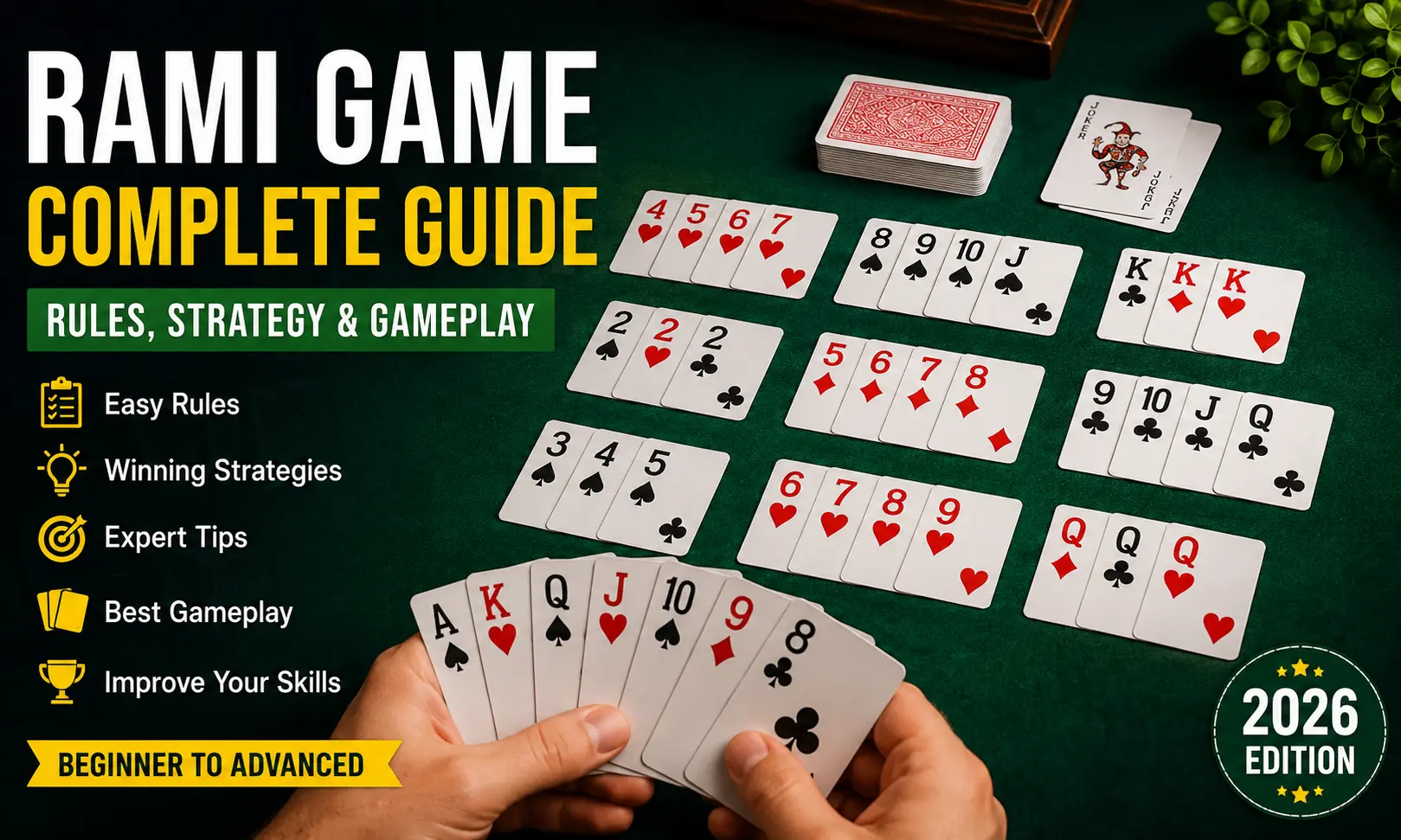
Introduction
The Rami game is one of the most popular card games enjoyed by millions of players around the world. Known for its perfect blend of skill, strategy, observation, and decision-making, Rami has remained a favorite for generations. Whether played with family during holidays, among friends at gatherings, or online through modern gaming platforms, the game continues to attract players of all ages.
Unlike games that rely primarily on luck, the Rami game rewards players who can think ahead, plan effectively, and adapt to changing situations. Every card drawn and discarded can influence the outcome, making every round exciting and unique.
In recent years, online Rami platforms have transformed the way people play. Mobile applications and websites now allow players to compete with opponents from different parts of the world, practice their skills, and enjoy various game formats anytime.
This complete guide will help beginners understand the fundamentals of the Rami game while also providing valuable insights for experienced players looking to improve their gameplay.
Table of Contents
- Introduction
- What is the Rami Game?
- History of the Rami Game
- Why the Rami Game is So Popular
- Basic Rules of the Rami Game
- Understanding Card Values
- What is a Sequence?
- Pure Sequence vs. Impure Sequence
- What is a Set in Rami?
- Popular Types of Rami Games
- Essential Rami Terms Every Beginner Should Know
- Benefits of Playing the Rami Game
- Why Beginners Should Practice Regularly
- Advanced Rami Strategies to Improve Your Game
- Common Mistakes Beginners Should Avoid
- Expert Tips for Consistent Success
- How to Improve Your Rami Skills
- Online Rami in 2026
- Responsible Gaming Tips
- Final Thoughts
- Conclusion
- Frequently Asked Questions (FAQs)
What is the Rami Game?
The Rami game is a matching card game where players aim to organize their cards into valid sequences and sets before their opponents.
The objective is simple:
- Arrange all cards into valid combinations.
- Form at least one pure sequence.
- Complete the remaining cards into sequences or sets.
- Declare before other players.
Although luck plays a small role in the cards received initially, success depends largely on skill, memory, observation, and strategic planning.
Players constantly evaluate which cards to keep, which to discard, and which combinations are most likely to help them complete a winning hand.
Because every decision matters, Rami remains challenging even after years of experience.
 Rummy
Rummy
Shiva Ji G| Jul 12, 2026| 15 min read
Rummy All: The Complete Guide to Playing, Winning, and Choosing the Best Rummy Apps in 2026
History of the Rami Game
The origins of Rami can be traced back several centuries. Historians believe the game evolved from earlier matching-card games played across Europe and Asia.
Over time, different countries introduced their own variations, resulting in numerous versions enjoyed today.
Traditional Rami was originally played using physical decks of cards during family gatherings and social occasions. As technology advanced, the game entered the digital era, allowing people to enjoy it online with friends and strangers alike.
Today, millions of players enjoy Rami on smartphones, tablets, and computers.
Its simple rules combined with strategic depth have made it one of the world’s most enduring card games.
Why is the Rami Game So Popular?
There are many reasons behind the lasting popularity of Rami.
1. Easy to Learn
Beginners can understand the basic rules within a short time.
Although mastering advanced strategies requires practice, anyone can start playing after learning the fundamentals.
2. Skill-Based Gameplay
Unlike many card games that rely heavily on chance, Rami emphasizes:
- Decision-making
- Memory
- Planning
- Observation
- Risk management
- all rummy
Experienced players often outperform beginners because of superior strategy.
3. Social Entertainment
Rami is commonly played:
- With family
- Among friends
- At social gatherings
- Online communities
The game encourages interaction and friendly competition.
4. Mental Exercise
Regular Rami players develop several cognitive skills, including:
- Pattern recognition
- Logical thinking
- Quick decision-making
- Memory improvement
- Concentration
This mental stimulation contributes to the game’s widespread appeal.
5. Multiple Variations
Players never become bored because several versions of Rami exist.
Different rules, scoring systems, and gameplay styles provide endless variety.
Basic Rules of the Rami Game
Before playing, beginners should understand the basic gameplay.
Number of Players
Most Rami games allow:
- 2 Players
- 3 Players
- 4 Players
- 6 Players (depending on the variation)
Deck Used
Typically:
- Two standard decks
- Printed Jokers
- Wild Jokers (depending on rules)
- rummy game
Objective
Arrange all cards into valid combinations before other players.
A valid declaration usually requires:
- One Pure Sequence
- One Additional Sequence
- Remaining cards arranged into sets or sequences
Gameplay Steps
Step 1
Each player receives cards.
Step 2
One card becomes the open card.
Another remains face down as the draw pile.
Step 3
Players take turns.
During each turn they:
- Pick one card
- Discard one card
Step 4
Players continue arranging cards.
Step 5
Once all cards form valid combinations, a player declares victory.
 Rummy
Rummy
Shiva Ji G| Jul 10, 2026| 20 min read
All Rummy: The Ultimate Guide to Online Rummy Games, Apps, Rules, Strategies & Safe Play in 2026
Understanding Card Values
Knowing card values helps beginners calculate possibilities quickly.
Generally:
| Card | Value |
|---|---|
| Ace | High or Low (depending on variation) |
| 2–10 | Face Value |
| Jack | 10 Points |
| Queen | 10 Points |
| King | 10 Points |
| Joker | Wild Card |
Card values become important when calculating scores after each round.
What is a Sequence?
A sequence is a group of consecutive cards belonging to the same suit.
Example:
- 4♥ 5♥ 6♥
or
- 8♠ 9♠ 10♠
Sequences are the foundation of winning.
Pure Sequence
A pure sequence contains:
- Same Suit
- Consecutive Cards
- No Joker
Example:
- 3♣ 4♣ 5♣
This is a valid pure sequence.
Every winning hand normally requires at least one pure sequence.
Impure Sequence
An impure sequence uses a Joker.
Example:
- 6♦ 7♦ Joker
The Joker substitutes the missing card.
Although valid, an impure sequence alone is insufficient for a winning declaration in most Rami formats because a pure sequence is generally mandatory.
What is a Set?
A set consists of cards having the same rank but different suits.
Example:
- 9♠
- 9♦
- 9♣
This forms a valid set.
Another example:
- King♣
- King♥
- King♠
Sets help complete the remaining cards after forming the required sequences.
Popular Types of Rami Games
Many versions exist across the world.
1. Points Rami
A quick format where players compete for the lowest score after valid declarations.
Ideal for short sessions.
2. Pool Rami
Players continue playing until they cross a fixed score limit.
The last remaining player wins.
3. Deals Rami
Players compete across a predetermined number of deals.
The player with the highest overall performance wins.
4. Classic Rami
Traditional gameplay focusing on sequences and sets.
Often played among families and friends.
5. Online Multiplayer Rami
Modern platforms allow players to:
- Join tournaments
- Play with friends
- Compete globally
- Practice anytime
This has significantly increased the popularity of the game.
Essential Rami Terms Every Beginner Should Know
Learning common terminology makes understanding the game much easier.
Joker
A card that substitutes another card in impure sequences or sets.
Wild Joker
A randomly selected card acting as a Joker during the game.
Draw Pile
The stack of face-down cards from which players draw.
Discard Pile
Cards discarded by players during gameplay.
Declaration
Announcing that all cards have been arranged into valid combinations.
Meld
A completed sequence or set.
Deadwood
Cards not arranged into valid combinations.
These increase a player’s score if another player declares first.
 Rummy
Rummy
Shiva Ji G| Jul 09, 2026| 11 min read
Yaar Win: A Complete Guide to the Platform, Features, User Experience, and Responsible Gaming
Benefits of Playing the Rami Game
Beyond entertainment, Rami offers several advantages.
Improves Memory
Players constantly remember:
- Opponents’ discarded cards
- Cards already picked
- Possible combinations
This strengthens short-term memory over time.
Develops Strategic Thinking
Every move affects future possibilities.
Good players think several turns ahead before making decisions.
Enhances Concentration
A brief distraction may cause players to miss valuable opportunities.
Regular gameplay improves focus and attention.
Strengthens Decision-Making
Players must quickly evaluate:
- Which card to keep
- Which card to discard
- Whether to pursue a sequence or a set
This helps sharpen analytical thinking.
Encourages Patience
Winning consistently requires discipline and careful planning rather than rushing into declarations.
Social Interaction
Whether played offline or online, Rami encourages communication, teamwork in friendly settings, and healthy competition among participants.
Why Beginners Should Practice Regularly
Like chess or other strategic games, improvement in Rami comes with consistent practice.
New players often focus only on completing combinations, while experienced players also observe opponents’ moves, predict needed cards, and minimize risk.
Practicing regularly helps players:
- Recognize patterns more quickly.
- Build stronger sequences.
- Improve card management.
- Develop confidence.
- Reduce mistakes during declarations.
Over time, these skills can significantly improve overall gameplay and enjoyment.
Advanced Rami Strategies to Improve Your Game
Once you understand the basic rules of the Rami game, the next step is developing strategies that increase your chances of winning. While luck influences the cards you receive, experienced players know that smart decisions throughout the game often determine the outcome.
1. Build a Pure Sequence First
The first priority in almost every Rami game should be completing a pure sequence. Since a valid declaration usually requires at least one pure sequence, focusing on it early reduces the risk of an invalid declaration.
Avoid using Jokers immediately if they can help complete a pure sequence naturally.
2. Observe Your Opponents
One of the most valuable skills in Rami is observation. Watch every card your opponents pick and discard.
Ask yourself:
- Which suit are they collecting?
- Are they building a sequence?
- Are they waiting for a specific card?
By tracking their moves, you can avoid discarding cards that may help them complete their combinations.
3. Use Jokers Wisely
Jokers are extremely useful but should not be wasted.
Instead of using a Joker in a combination that can easily be completed naturally, save it for difficult sequences or sets where obtaining the required card is unlikely.
Proper Joker management often separates beginners from experienced players.
4. Discard High-Value Cards Early
Face cards such as Kings, Queens, and Jacks generally carry higher penalty points if another player declares before you.
If these cards are not contributing to a useful combination, consider discarding them early to reduce potential losses.
5. Keep Your Hand Organized
Arrange your cards by suit and sequence possibilities. A well-organized hand helps you identify opportunities faster and reduces mistakes during gameplay.
Many experienced players rearrange their cards after every turn to maintain a clear overview.
6. Avoid Holding Useless Cards
Every card in your hand should have a purpose. If a card cannot realistically become part of a sequence or set, it is usually better to discard it instead of hoping for an unlikely draw.
7. Plan Several Turns Ahead
Strong Rami players think beyond the current move. Before drawing or discarding, consider how that decision might affect your hand over the next few turns.
Planning ahead helps you adapt more effectively as the game progresses.
 Rummy
Rummy
Shiva Ji G| Jul 09, 2026| 18 min read
Indian Rummy: The Complete Guide to India’s Most Popular Card Game (2026)
Common Mistakes Beginners Should Avoid
Many new players lose games because of avoidable errors rather than poor cards.
Ignoring the Pure Sequence
Trying to complete multiple sets before forming a pure sequence can lead to an invalid declaration.
Always prioritize the pure sequence.
Declaring Too Quickly
Some players declare as soon as they believe their hand is complete without carefully checking every combination.
A single mistake can invalidate the declaration and result in a significant penalty.
Take a few extra seconds to verify your hand before declaring.
Depending Too Much on Jokers
While Jokers are valuable, relying entirely on them can limit your flexibility.
Aim to create natural combinations whenever possible.
Discarding Useful Cards
Discarding cards that may complete your own future sequence is a common beginner mistake.
Evaluate each discard carefully before placing it in the discard pile.
Forgetting Opponent Behavior
Winning is not only about your own cards. Observing your opponents can provide valuable information that influences your decisions.
Ignoring their actions means missing strategic opportunities.
Expert Tips for Consistent Success
Professional and experienced players often follow a disciplined approach rather than depending on luck.
Here are some practical tips:
- Practice regularly to recognize patterns more quickly.
- Stay patient during difficult hands.
- Avoid emotional decisions after a poor draw.
- Learn from every game you play.
- Watch experienced players to understand advanced techniques.
- Experiment with different strategies.
- Stay focused until the final turn.
- Review your mistakes after each game.
Consistency is more important than occasional lucky wins.
How to Improve Your Rami Skills
Improving your Rami performance requires both knowledge and experience.
Practice Daily
Even short practice sessions help reinforce strategies and improve decision-making.
Learn Multiple Variations
Different versions of Rami introduce unique rules and scoring systems.
Understanding these variations makes you a more adaptable player.
Study Winning Patterns
Review successful hands and analyze how winning combinations were formed.
Recognizing common patterns speeds up your decision-making during future games.
Strengthen Memory
Try remembering:
- Recently discarded cards
- Cards picked by opponents
- Missing cards in your combinations
Improved memory leads to smarter gameplay.
Online Rami in 2026
Technology has made Rami more accessible than ever. Players can now enjoy games on smartphones, tablets, and computers from virtually anywhere with an internet connection.
Modern online platforms often include:
- Beginner-friendly tutorials
- Practice tables
- Multiplayer matches
- Private games with friends
- Leaderboards
- Seasonal events
- Secure player accounts
- Smooth cross-device gameplay
These features make learning and improving easier than ever before.
Responsible Gaming Tips
Whether you play casually or competitively, responsible gaming should always come first.
Keep these practices in mind:
- Play for enjoyment rather than pressure.
- Set reasonable time limits.
- Take regular breaks during long sessions.
- Avoid making impulsive decisions.
- Maintain a healthy balance between gaming and daily responsibilities.
- If playing on platforms that involve money, understand the rules, risks, and local laws before participating.
Responsible habits help ensure that the game remains entertaining and enjoyable.
Frequently Asked Questions
Is Rami a game of skill or luck?
While the initial cards are dealt randomly, long-term success depends primarily on skill, including observation, planning, memory, and strategic decision-making.
How important is the pure sequence?
A pure sequence is one of the most important elements in most Rami formats. Without it, a declaration is often considered invalid.
Can beginners learn Rami quickly?
Yes. Most beginners can understand the basic rules within a short time. With regular practice, they can steadily improve their strategic skills.
How long does a typical game last?
The duration depends on the variation being played and the number of participants. Some formats can finish in just a few minutes, while others may take considerably longer.
Does practice really improve performance?
Absolutely. As players gain experience, they become better at recognizing patterns, managing cards, predicting opponents’ moves, and making informed decisions.
Final Thoughts
The Rami game has stood the test of time because it combines straightforward rules with meaningful strategic depth. Every match offers a fresh challenge, requiring players to think critically, adapt to changing situations, and make calculated decisions.
Whether you’re playing with family, friends, or online opponents, the skills you develop through Rami—such as patience, concentration, memory, and logical thinking—can make the experience both enjoyable and intellectually rewarding.
Remember that improvement comes gradually. Even experienced players continue learning new strategies and refining their decision-making with every game they play.
Conclusion
The Rami game remains one of the most enjoyable and intellectually rewarding card games, combining strategy, observation, patience, and decision-making in every round. While the rules are simple enough for beginners to learn, mastering the game requires consistent practice, careful planning, and the ability to adapt to changing situations.
Whether you prefer playing with family and friends or exploring online Rami platforms, understanding the fundamentals—such as creating a pure sequence, forming valid sets, managing Jokers effectively, and observing your opponents—can significantly improve your performance. Every game offers an opportunity to sharpen your skills, develop better strategies, and gain valuable experience.
For beginners, the key is to focus on learning the rules thoroughly and practicing regularly rather than worrying about winning every match. Experienced players, on the other hand, can continue refining their techniques by studying advanced strategies, minimizing mistakes, and staying patient throughout each game.
As the popularity of digital card games continues to grow in 2026, the Rami game remains a timeless favorite for players of all ages. Whether you’re looking for entertainment, a mental challenge, or a chance to improve your strategic thinking, Rami offers an engaging and rewarding experience.
Start with the basics, practice consistently, play responsibly, and enjoy the excitement that every Rami game brings. With dedication and smart gameplay, you’ll build confidence, improve your skills, and enjoy this classic card game for years to come.
Frequently Asked Questions (FAQs)
Rami is a popular card game in which players arrange their cards into valid sequences and sets before their opponents. The primary objective is to organize all the cards into proper combinations while following the game’s rules. In most versions of Rami, a player must create at least one pure sequence before making a valid declaration. Beginners can start by learning the basic rules, understanding card values, and practicing with friends or on online platforms that offer beginner-friendly games. Consistent practice helps players recognize card patterns, improve decision-making, and develop winning strategies. Starting with casual games is an excellent way to build confidence before moving on to more competitive matches.
The basic rules of the Rami game are simple to understand but require strategic thinking to master. Each player is dealt a fixed number of cards from one or more standard decks. Players take turns drawing one card from either the draw pile or the discard pile and then discarding one card. The goal is to arrange all cards into valid sequences and sets. A winning hand generally requires at least one pure sequence, while the remaining cards can be organized into additional sequences or sets. Players should carefully observe opponents’ moves, manage Jokers wisely, and avoid making an invalid declaration. Learning these core rules forms the foundation for becoming a skilled Rami player.
Although players receive cards randomly at the beginning of each game, Rami is widely regarded as a game that rewards skill over time. Success depends on strategic planning, observation, memory, and decision-making rather than luck alone. Skilled players know when to keep or discard cards, how to create efficient sequences, and how to predict opponents’ strategies. They also understand the importance of building a pure sequence early and using Jokers effectively. While luck may influence a single game, consistent performance over many games is generally determined by a player’s experience, strategy, and ability to adapt to changing situations during gameplay.
Improving at Rami requires patience, practice, and smart gameplay. One of the most effective strategies is to complete a pure sequence as early as possible. Players should organize their cards carefully, monitor the discard pile, and observe the cards picked by opponents to predict their combinations. Avoid holding high-value cards for too long if they are not contributing to useful sequences or sets, as they can increase penalty points. Jokers should be used strategically rather than immediately. Regular practice, reviewing previous games, and learning from experienced players can significantly improve decision-making, pattern recognition, and overall performance.
Yes, many online platforms allow players to enjoy the Rami game safely and conveniently. Before joining any platform, choose a reputable service with transparent rules, secure payment systems (where applicable), privacy protection, and responsible gaming features. Read the platform’s terms and conditions carefully and understand the game rules before participating. Beginners should start with free practice games to improve their skills before entering competitive matches. It’s also important to set personal time and spending limits, play responsibly, and remember that the primary purpose of the game is entertainment. Responsible gaming habits help ensure a positive and enjoyable experience while playing online.
Leave a Reply