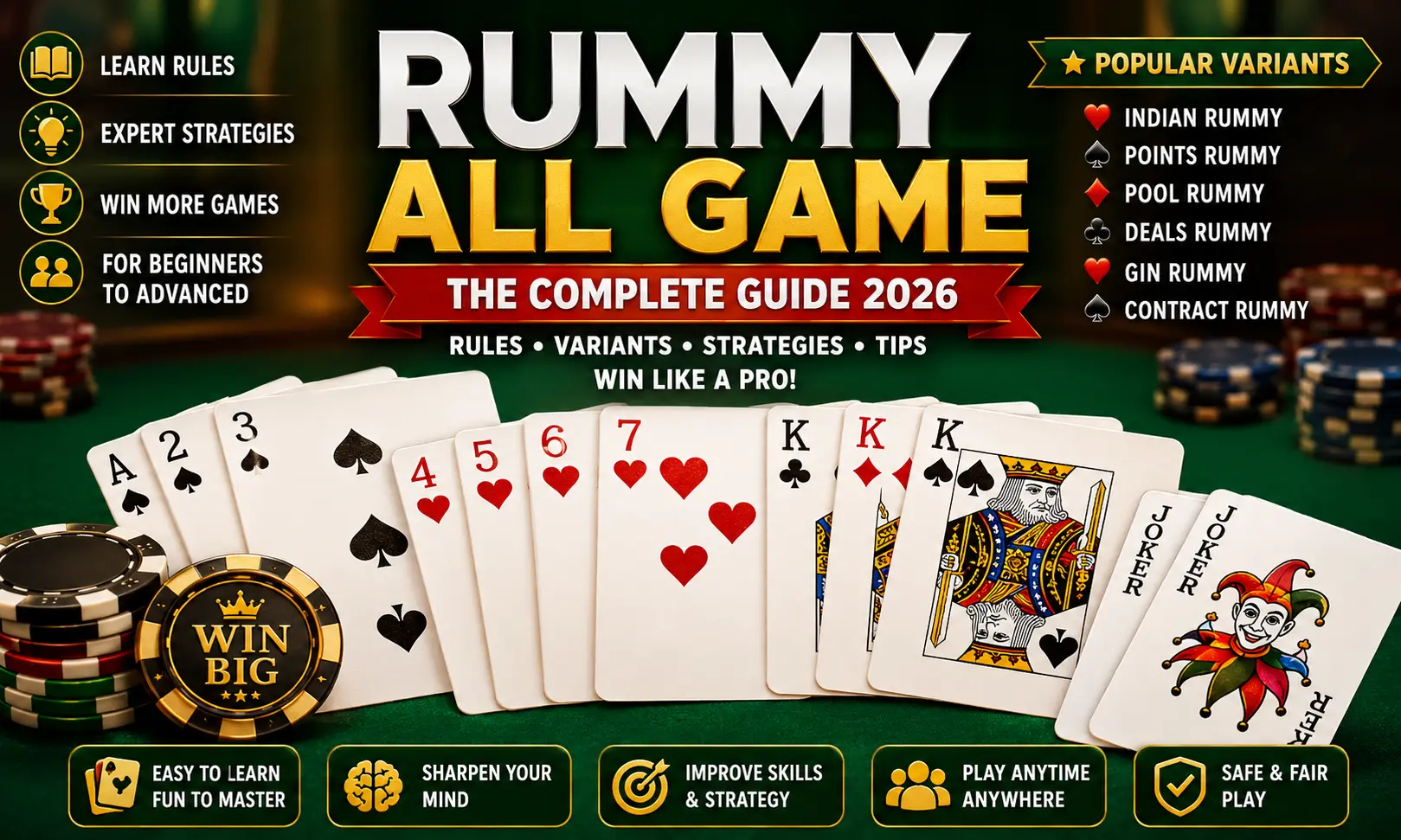
Rummy is one of the world’s most popular card games and continues to attract millions of players every year. Whether you enjoy playing with family, friends, or on digital platforms, rummy offers an exciting combination of skill, strategy, observation, and decision-making.
The phrase “Rummy All Game“ generally refers to every major variation of the rummy card game available worldwide. Instead of representing a single game, it includes numerous formats such as Indian Rummy, Gin Rummy, Pool Rummy, Points Rummy, Deals Rummy, Contract Rummy, Canasta, Oklahoma Rummy, and many more.
In 2026, online gaming platforms have made these variations more accessible than ever before. Players can learn different formats, improve their strategic thinking, and enjoy competitive gameplay from almost anywhere.
This comprehensive guide explains everything you need to know about Rummy All Game—from its history and rules to expert strategies and modern gameplay tips.
Table of Contents
- Introduction to Rummy All Game
- What is Rummy?
- History of Rummy Games
- Why Rummy is Popular in 2026
- Understanding Rummy All Game
- Different Types of Rummy Games
- Indian Rummy
- Points Rummy
- Pool Rummy
- Deals Rummy
- Gin Rummy
- Contract Rummy
- Canasta
- Basic Rules of Rummy
- How to Play Rummy All Game
- Understanding Sequences
- Understanding Sets
- Pure Sequence vs. Impure Sequence
- Card Values and Scoring System
- Role of Jokers in Rummy
- Advanced Winning Strategies
- Expert Tips to Improve Your Rummy Skills
- Common Mistakes to Avoid
- Online Rummy vs. Offline Rummy
- How to Choose the Best Rummy Variant
- Benefits of Playing Rummy
- Responsible Gaming Tips
- The Future of Rummy in 2026 and Beyond
- Final Thoughts
- Conclusion
- Frequently Asked Questions (FAQs)
What is Rummy?
Rummy is a skill-based card game where players arrange cards into valid combinations.
The primary objective is to organize cards into:
- Pure Sequences
- Impure Sequences
- Valid Sets
A player wins after successfully arranging all cards according to the game’s rules before the opponents.
Unlike games that rely mostly on luck, rummy rewards:
- Observation
- Memory
- Planning
- Probability analysis
- Smart decision-making
This is why experienced players generally perform better over time.
 Rummy
Rummy
SH Shiva Ji G| Jul 13, 2026| 17 min read
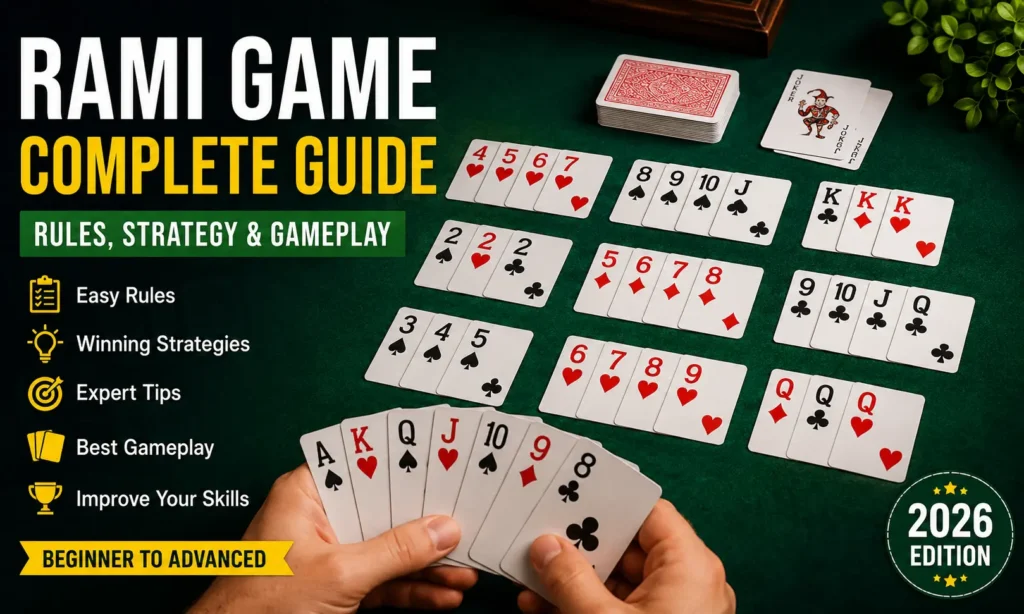
Rami Game: The Complete Beginner’s Guide to Rules, Strategy & Gameplay (2026)
The History of Rummy Games
Although historians debate the exact origin of rummy, most believe the game evolved from older European matching-card games during the nineteenth century.
Over decades, regional adaptations created entirely new versions.
Some of today’s most popular variants include:
- Indian Rummy
- Gin Rummy
- Oklahoma Rummy
- Kalooki
- Contract Rummy
- Canasta
- Shanghai Rummy
Each version introduces unique rules while preserving the core concept of forming sequences and sets.
The internet era has accelerated the popularity of these games, allowing players worldwide to compete in real time.
Why Rummy is So Popular in 2026
The popularity of rummy continues to grow because it offers more than simple entertainment.
Major reasons include:
Skill-Based Gameplay
Success depends on strategy rather than pure luck.
Players constantly improve through practice.
Easy to Learn
Basic rules can be understood within minutes.
However, mastering advanced strategies requires experience.
Multiple Game Modes
Players can enjoy:
- Quick games
- Tournament formats
- Practice tables
- Multiplayer competitions
Mobile Accessibility
Modern applications allow users to play anywhere using smartphones or tablets.
Continuous Learning
Every match feels different because:
- Cards change
- Opponents play differently
- Strategies evolve
This prevents the gameplay from becoming repetitive.
Understanding Rummy All Game
When people search for Rummy All Game, they are usually looking for information about every major rummy variation available.
Some of the most popular versions include:
- Indian Rummy
- Gin Rummy
- Pool Rummy
- Deals Rummy
- Points Rummy
- Contract Rummy
- Canasta
- Kalooki
- Shanghai Rummy
- Dummy Rummy
- Oklahoma Rummy
Each format introduces its own scoring system, objectives, and gameplay style.
Indian Rummy
Indian Rummy is among the most popular versions worldwide.
It is generally played using:
- Two decks
- Printed Jokers
- Two to six players
Each player receives 13 cards.
The goal is to create:
- One Pure Sequence
- One Additional Sequence
- Remaining Sets
Without a pure sequence, a declaration is invalid.
Key Features
- Fast-paced gameplay
- High strategic value
- Skill-focused
- Multiple tournament formats
- Popular online
Points Rummy
Points Rummy is designed for players who enjoy short matches.
Characteristics include:
- Single round
- Fast completion
- Direct scoring
- Beginner-friendly
Many players prefer Points Rummy because each game usually lasts only a few minutes.
Pool Rummy
Pool Rummy emphasizes survival rather than immediate victory.
Players accumulate points after losing rounds.
Once a player reaches the elimination score, they leave the game.
The last remaining player wins.
Common formats include:
- 101 Pool
- 201 Pool
Deals Rummy
Deals Rummy is played for a predetermined number of rounds.
Instead of playing until elimination, participants compete across fixed deals.
The player with the lowest cumulative score after all deals wins.
This format rewards consistent performance.
Gin Rummy
Gin Rummy originated in the United States and remains extremely popular.
Unlike Indian Rummy:
- Uses one deck
- Usually two players
- Faster gameplay
- Different scoring system
Players continuously improve their hand while attempting to “Knock” or achieve “Gin.”
Contract Rummy
Contract Rummy introduces changing objectives throughout the game.
Each round requires players to complete specific contracts.
Examples include:
- Two Sets
- One Sequence
- Three Sets
- Four Runs
The required combinations become progressively more difficult.
This creates excellent strategic depth.
Canasta
Canasta is another famous member of the rummy family.
Features include:
- Partnership gameplay
- Two decks
- Wild cards
- Large scoring combinations
It is especially popular among experienced card players.
 Rummy
Rummy
Shiva Ji G| Jul 12, 2026| 15 min read
Rummy All: The Complete Guide to Playing, Winning, and Choosing the Best Rummy Apps in 2026
Basic Rules of Rummy
Although rules vary slightly among formats, the fundamental principles remain consistent.
Players:
- Draw one card.
- Discard one card.
- Build valid combinations.
- Observe opponents.
- Complete the required sequences first.
- Declare before opponents.
Winning depends on constructing a valid hand.
Understanding Sequences
Sequences are consecutive cards belonging to the same suit.
Example:
5♥ 6♥ 7♥
This is a valid sequence.
Longer Example
7♠ 8♠ 9♠ 10♠ J♠
This is also valid.
Longer sequences increase flexibility during gameplay.
Understanding Sets
Sets contain identical card values from different suits.
Example:
8♣ 8♦ 8♥
Another example:
K♠ K♦ K♣ K♥
These combinations are extremely useful for reducing points.
Pure Sequence
A Pure Sequence contains no Joker.
Example:
4♠ 5♠ 6♠
or
9♦ 10♦ J♦
Every winning hand generally requires at least one pure sequence.
Impure Sequence
An Impure Sequence uses one or more Jokers.
Example:
6♣ 7♣ Joker
Another example:
Q♥ Joker A♥
Jokers increase flexibility but cannot replace the mandatory pure sequence requirement in many rummy formats.
Card Values
Most rummy games use these values:
- Ace = 10 or 1 (depending on rules)
- Face Cards = 10
- Number Cards = Face Value
- Joker = Wild Card
Understanding card values helps minimize penalties.
Importance of Jokers
Jokers are among the strongest cards in rummy.
They help complete:
- Sets
- Sequences
- Difficult combinations
However, experienced players avoid relying entirely on Jokers.
Building a natural hand provides greater flexibility.
Beginner Tips
If you’re new to rummy:
- Focus on the pure sequence first.
- Discard high-value cards early if unused.
- Observe opponent discards.
- Avoid holding too many unmatched cards.
- Practice regularly.
- Learn different variants.
These habits significantly improve long-term performance.
Advanced Winning Strategies for Rummy All Game
Learning the rules of rummy is only the beginning. To become a consistent winner, you need to develop strategic thinking, improve your observation skills, and make informed decisions during every turn. Experienced players rarely rely on luck alone—they focus on planning several moves ahead.
Below are some of the most effective strategies that can improve your gameplay.
1. Create a Pure Sequence First
Your highest priority should always be completing a pure sequence. In most rummy variants, you cannot make a valid declaration without one. Waiting too long to build it can leave you with an incomplete hand even if the rest of your cards are well organized.
Once your pure sequence is secured, you can use jokers more freely to complete the remaining combinations.
2. Observe Opponent Discards
Every discarded card reveals valuable information. If an opponent repeatedly picks cards from one suit or avoids discarding certain ranks, you can often predict the combinations they are trying to build.
Avoid discarding cards that are likely to help them complete a sequence or set.
3. Reduce High-Value Cards Early
Face cards and aces generally carry high penalty points. If they don’t fit into your planned combinations, discard them early instead of holding them throughout the game.
Reducing high-value cards minimizes your loss if another player declares unexpectedly.
4. Use Jokers Wisely
Jokers are powerful, but they should not be wasted on easy combinations. Save them for difficult sequences or sets where finding the required natural card is unlikely.
Strategic joker usage often determines the outcome of closely contested games.
5. Plan Multiple Combinations
Avoid depending on only one possible arrangement of your cards. Skilled players maintain two or three potential combinations while waiting for better draws.
This flexibility allows you to adapt quickly as the game develops.
6. Track Picked Cards
Remembering which cards have already been picked or discarded helps estimate the probability of receiving the cards you need.
The better your memory, the stronger your decision-making becomes.
 Rummy
Rummy
Shiva Ji G| Jul 10, 2026| 20 min read
All Rummy: The Ultimate Guide to Online Rummy Games, Apps, Rules, Strategies & Safe Play in 2026
Expert Tips to Improve Your Rummy Skills
Improvement comes from consistent practice and disciplined decision-making. Consider the following habits:
- Practice regularly before entering competitive games.
- Learn every major rummy variation.
- Stay calm during long matches.
- Avoid emotional decisions after losing rounds.
- Analyze your mistakes after each game.
- Focus on probability instead of hope.
- Develop patience instead of rushing declarations.
- Continuously improve your observation skills.
Even experienced players keep refining these fundamentals.
Common Mistakes to Avoid
Many beginners lose games because of avoidable errors.
Ignoring the Pure Sequence
Trying to build attractive sets before completing the mandatory pure sequence often results in invalid declarations.
Holding High Cards Too Long
Keeping kings, queens, jacks, or aces without a clear purpose increases penalty points if an opponent declares first.
Wasting Jokers
Using jokers to complete combinations that could easily be formed naturally reduces your flexibility later in the game.
Declaring Too Quickly
Many players rush to declare without carefully checking whether every card belongs to a valid sequence or set.
A wrong declaration can lead to significant penalties.
Ignoring Opponent Behavior
Successful players pay attention to what others pick and discard. Ignoring these clues means missing valuable strategic information.
Online Rummy vs Offline Rummy
Although both versions share the same basic rules, the experience differs considerably.
| Feature | Online Rummy | Offline Rummy |
|---|---|---|
| Accessibility | Available anytime | Requires players to gather |
| Speed | Fast-paced | Usually slower |
| Practice Options | Unlimited | Limited |
| Multiplayer | Global players | Friends and family |
| Learning | Tutorials available | Self-learning |
| Tournaments | Frequently available | Rare |
Online platforms also allow players to practice different formats without arranging physical games.
How to Choose the Best Rummy Variant
Different players enjoy different styles of gameplay.
Choose Points Rummy if you:
- Prefer quick games
- Have limited time
- Enjoy fast decision-making
Choose Pool Rummy if you:
- Like longer strategic matches
- Prefer elimination-based gameplay
- Enjoy planning over multiple rounds
Choose Deals Rummy if you:
- Enjoy consistency
- Like fixed numbers of rounds
- Prefer balanced competition
Choose Gin Rummy if you:
- Mostly play one-on-one
- Enjoy fast tactical matches
- Like simple scoring
Choose Contract Rummy if you:
- Want changing objectives
- Prefer advanced strategic planning
- Enjoy more complex gameplay
Trying several variants is the best way to discover which suits your playing style.
 Rummy
Rummy
Shiva Ji G| Jul 09, 2026| 11 min read
Yaar Win: A Complete Guide to the Platform, Features, User Experience, and Responsible Gaming
Benefits of Playing Rummy
Rummy is more than entertainment. Regular play can help develop several mental skills:
- Logical thinking
- Strategic planning
- Memory improvement
- Better concentration
- Decision-making under pressure
- Patience
- Pattern recognition
- Risk assessment
These skills make rummy engaging for players of all experience levels.
Responsible Gaming Tips
If you play online, maintaining healthy gaming habits is essential.
- Set a fixed time limit before starting.
- Take regular breaks.
- Avoid chasing losses.
- Play within your budget.
- Keep gaming enjoyable rather than stressful.
- Balance gaming with work, family, and other hobbies.
- Never let emotions dictate your decisions.
Responsible play helps ensure that rummy remains a fun and skill-focused activity.
The Future of Rummy in 2026 and Beyond
Rummy continues to evolve with technology. Several trends are shaping its future:
- Improved mobile gaming experiences
- Faster matchmaking systems
- Enhanced security and fair-play technology
- Artificial intelligence for tutorials and practice
- Cross-platform compatibility
- Interactive tournaments and events
- Better graphics and user interfaces
- Wider global participation
As digital gaming grows, rummy is expected to remain one of the most popular skill-based card games worldwide.
Final Thoughts
The term Rummy All Game represents an entire family of exciting card games rather than a single format. Whether you enjoy Indian Rummy, Gin Rummy, Pool Rummy, Deals Rummy, or Contract Rummy, each variation offers unique challenges that reward strategic thinking and continuous learning.
Success in rummy depends on understanding the rules, building a pure sequence early, observing opponents carefully, managing high-value cards wisely, and practicing consistently. By developing these habits, players can steadily improve their skills and enjoy every match more confidently.
Conclusion
Rummy has remained popular for generations because it combines entertainment with strategy and skill. Every variant introduces its own style of play while retaining the core objective of forming valid sequences and sets.
Whether you are a beginner learning the basics or an experienced player refining advanced strategies, mastering the fundamentals and practicing regularly are the keys to long-term success. Explore different versions, play responsibly, and focus on improving your decision-making with each game.
With patience and experience, you’ll gain a deeper appreciation for the strategic depth that makes rummy one of the world’s most enduring card games.
Frequently Asked Questions (FAQs) About Rummy All Game
The term Rummy All Game refers to a collection of different rummy card game variants rather than a single game. It includes popular versions such as Indian Rummy, Points Rummy, Pool Rummy, Deals Rummy, Gin Rummy, Contract Rummy, Canasta, and several regional variations. While each variant has its own rules, scoring system, and gameplay style, they all share the same objective: arranging cards into valid sequences and sets before your opponents.
Regular Rummy often refers specifically to Indian Rummy, where players receive 13 cards and must create at least one pure sequence, another valid sequence, and the remaining cards in sets or sequences. In contrast, Rummy All Game covers every major format, giving players the flexibility to choose the version that best suits their experience level and preferences. Beginners usually start with Points Rummy because of its quick gameplay, while experienced players may prefer Pool or Deals Rummy for their deeper strategic elements. Understanding multiple variants helps players improve their card-reading abilities, strategic thinking, and adaptability, making the overall rummy experience more enjoyable and rewarding.
Although the rules vary slightly between different versions, the basic principles remain the same. Each player is dealt a fixed number of cards and must arrange them into valid combinations. A valid declaration generally includes at least one pure sequence (a sequence without a joker), another sequence or set, and all remaining cards organized into legal combinations according to the game’s rules.
Players take turns drawing one card from either the open or closed deck and discarding one unwanted card. The challenge lies in deciding which cards to keep, which to discard, and how to prevent opponents from completing their hands. Jokers can often substitute for missing cards, but they usually cannot replace the mandatory pure sequence. Success depends on observation, planning, memory, and making smart decisions throughout the game. Practicing these fundamentals consistently will significantly improve your performance regardless of the rummy variant you play.
For beginners, Points Rummy is generally considered the best starting point because it has simple rules, quick rounds, and a straightforward scoring system. Each game is completed in a single round, allowing new players to learn without committing to long sessions. It also helps beginners understand important concepts such as creating pure sequences, forming valid sets, using jokers effectively, and managing high-value cards.
After gaining confidence in Points Rummy, players can explore more advanced formats like Pool Rummy, Deals Rummy, or Gin Rummy. Pool Rummy emphasizes long-term strategy across multiple rounds, while Deals Rummy rewards consistent performance over a fixed number of deals. Gin Rummy offers fast-paced two-player gameplay with different scoring mechanics. Regardless of the variant you choose, regular practice, careful observation of opponents, and learning from each game are the best ways to improve your skills and become a more confident rummy player.
Winning consistently in Rummy All Game requires more than good cards—it requires smart strategy. The first priority should always be completing a pure sequence as early as possible because it is mandatory in many rummy formats. Once your pure sequence is secure, you can focus on building additional sequences and sets using jokers strategically.
Experienced players also pay close attention to the cards their opponents pick and discard. These actions often reveal the combinations opponents are trying to build, allowing you to avoid giving them useful cards. Discarding high-value cards that don’t fit your hand early in the game can reduce penalty points if another player declares first. Maintaining multiple possible combinations instead of relying on a single plan increases flexibility and improves your chances of completing a valid hand. Above all, patience, observation, and regular practice are the most valuable skills for long-term success in rummy.
Rummy is widely recognized as a game that primarily rewards skill, although luck can influence individual hands. The cards dealt at the beginning are random, but the outcome of the game depends largely on how players use those cards. Strategic decisions—such as choosing which cards to keep, when to discard, how to use jokers, and how to read opponents’ moves—play a far greater role than chance over the long run.
Skilled players consistently outperform beginners because they understand probability, recognize patterns, remember discarded cards, and adapt their strategies as the game progresses. They also know how to minimize losses when they receive a weak hand and maximize opportunities when they receive a strong one. Continuous learning, regular practice, and disciplined decision-making help players improve steadily over time. Whether you enjoy Indian Rummy, Gin Rummy, Pool Rummy, or any other variant, developing these strategic skills will enhance both your performance and your overall enjoyment of the game.
Leave a Reply