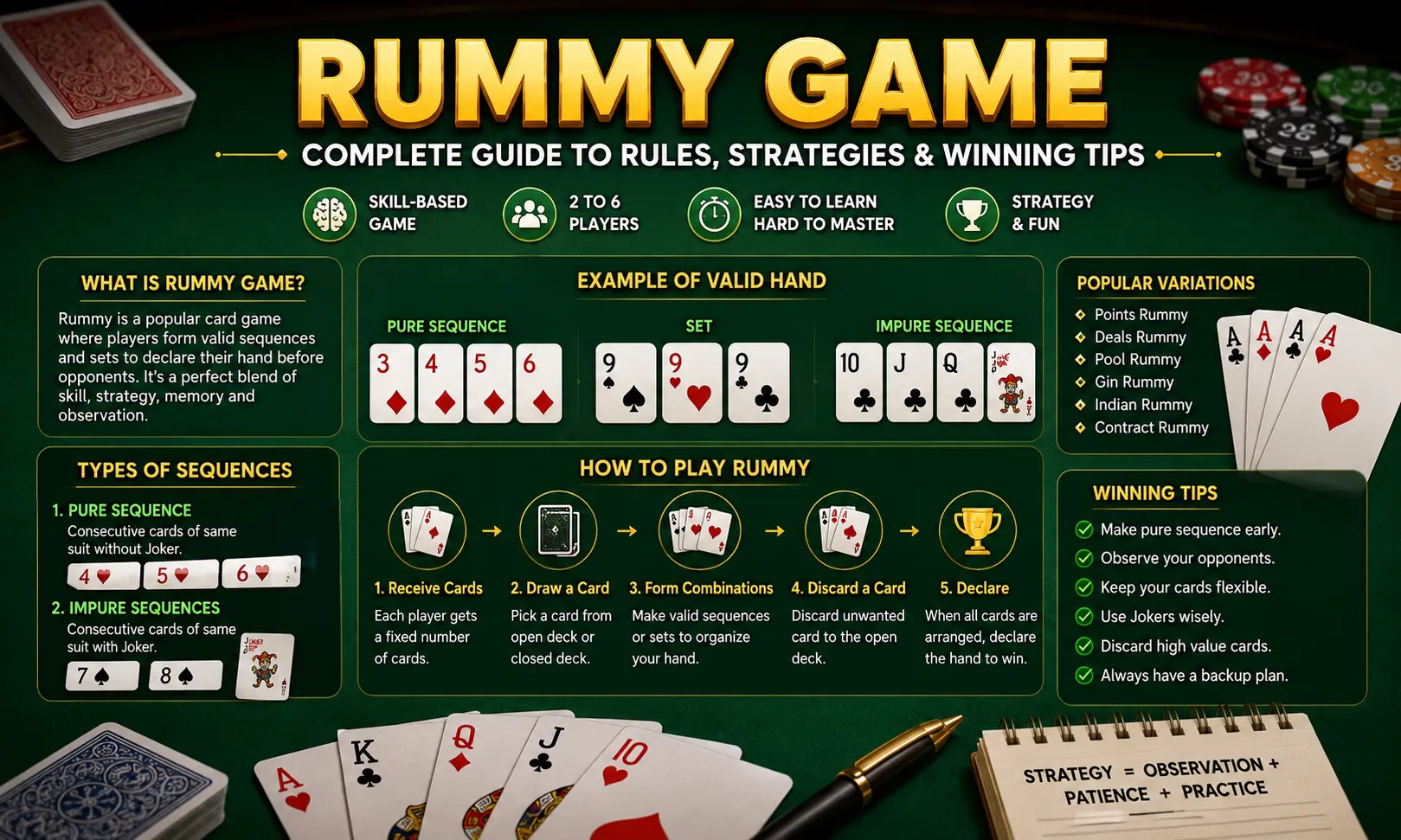
Introduction
The rummy game is one of the most popular card games enjoyed by millions of players worldwide. Combining skill, strategy, observation, and decision-making, rummy has evolved from a traditional family card game into a widely played online gaming experience. Whether you’re a beginner learning the basics or an experienced player looking to improve your skills, understanding the fundamentals of the rummy game can significantly increase your chances of winning.
The popularity of the rummy game has surged in recent years due to the rise of digital platforms and mobile applications. Today, players can enjoy rummy anytime and anywhere while competing against opponents from across the globe.
In this comprehensive guide, you’ll learn everything about the rummy game, including its history, rules, card sequences, gameplay strategies, common mistakes, and expert tips.
Table of Contents
- What Is a Rummy Game?
- History of the Rummy Game
- Why the Rummy Game Is So Popular
- Basic Rules of the Rummy Game
- Understanding Cards and Decks
- Objective of the Rummy Game
- Types of Sequences in Rummy
- Sets and Their Importance
- How to Play a Rummy Game Step-by-Step
- Essential Terms Every Player Should Know
- Popular Variations of the Rummy Game
- Beginner Strategies for Winning
- Advanced Winning Techniques
- Common Mistakes to Avoid
- Psychological Skills in Rummy
- Conclusion
- FAQs
What Is a Rummy Game?
A rummy game is a matching-card game where players arrange cards into valid sequences and sets. The primary objective is to organize all the cards in hand into proper combinations before opponents do.
Unlike games that depend mainly on luck, rummy requires:
- Strategic thinking
- Memory skills
- Card observation
- Risk management
- Decision-making abilities
- all rummy
The player who successfully forms valid combinations and declares first wins the game.
 Rummy
Rummy
SH Shiva Ji G| Jun 21, 2026| 12 min read
Rummy Game: The Ultimate Guide to Rules, Strategies, Variations, and Winning Tips in 2026
History of the Rummy Game
The exact origins of the rummy game remain debated among historians. However, most experts believe that modern rummy evolved from earlier matching card games played in Europe during the 18th and 19th centuries.
Over time, the game spread across continents and developed into multiple variations.
Some major milestones include:
Early European Influence
Many scholars link rummy to older card games played in Spain and Mexico.
Expansion Across Asia
The game gained enormous popularity throughout Asian countries, where local rules and formats emerged.
Online Revolution
With advancements in technology, the rummy game entered the digital world. Mobile apps and gaming websites introduced millions of new players to online rummy.
Today, the rummy game continues to grow due to its perfect balance of skill and entertainment.
Why the Rummy Game Is So Popular
Several factors contribute to the popularity of the rummy game.
Easy to Learn
The basic rules are straightforward, allowing beginners to start playing quickly.
Skill-Based Gameplay
Unlike many card games, success in rummy depends heavily on player skill.
Social Entertainment
Friends and family often gather to enjoy rummy together.
Mental Exercise
The game helps improve:
- Concentration
- Memory
- Analytical thinking
- Strategic planning
- rummy
Online Accessibility
Players can enjoy the rummy game on smartphones, tablets, and computers.
 Rummy
Rummy
Shiva Ji G| Jun 20, 2026| 13 min read
Popular Rummy Game: The Complete Guide to Rules, Variations, Strategies, and Online Play
Basic Rules of the Rummy Game
Before playing, it’s important to understand the basic rules.
Number of Players
Most rummy games involve:
- 2 players
- 3 players
- 4 players
- 6 players
Some variations support even larger groups.
Card Distribution
Each player receives a predetermined number of cards depending on the variation.
Generally:
- 13 cards in standard rummy
- Different counts in specific formats
Drawing and Discarding
During each turn:
- Draw one card.
- Form sequences or sets.
- Discard one unwanted card.
- all rummy apps
The process continues until someone makes a valid declaration.
Understanding Cards and Decks
A standard rummy game uses one or more decks of cards.
Card Rankings
Cards rank as follows:
- Ace
- King
- Queen
- Jack
- 10 through 2
Depending on the variation, Ace may function as:
- Lowest card
- Highest card
- Both
- rummy nabob
Joker Cards
Jokers play a crucial role in many rummy formats.
They can substitute missing cards and help complete combinations faster.
Example:
5♥ 6♥ Joker
The Joker acts as 7♥.
Objective of the Rummy Game
The goal of the rummy game is simple:
Arrange all cards into:
- Valid sequences
- Valid sets
- top rummy
Then declare before opponents.
A valid hand generally requires:
One Pure Sequence
A pure sequence contains consecutive cards of the same suit without a Joker.
Example:
- 4♠ 5♠ 6♠
Additional Sequences or Sets
The remaining cards must also form valid combinations.
The player with a complete hand wins.
 Rummy
Rummy
Shiva Ji G| Jun 20, 2026| 23 min read
Rummy Top: The Ultimate Guide to the Best Rummy Experience, Winning Strategies, and Top Platforms in 2026
Types of Sequences in Rummy
Sequences are the foundation of every rummy game.
Pure Sequence
A pure sequence contains:
- Consecutive cards
- Same suit
- No Joker
Examples:
- 3♦ 4♦ 5♦
- 7♣ 8♣ 9♣
A pure sequence is mandatory in most rummy formats.
Impure Sequence
An impure sequence uses a Joker.
Examples:
- 6♥ 7♥ Joker
- 9♠ Joker J♠
Although useful, an impure sequence cannot replace the requirement for a pure sequence.
Long Sequence
Some players create longer sequences for flexibility.
Examples:
- 4♣ 5♣ 6♣ 7♣ 8♣
Long sequences reduce the number of unmatched cards.
Sets and Their Importance
A set consists of cards sharing the same rank but different suits.
Examples:
- 7♠ 7♥ 7♣
- K♠ K♦ K♥
Rules for Sets
A valid set must:
- Have at least three cards
- Use different suits
- Avoid duplicate suits
Incorrect:
- 9♠ 9♠ 9♦
Correct:
- 9♠ 9♥ 9♦
Sets help players reduce points and complete valid hands efficiently.
How to Play a Rummy Game Step-by-Step
Understanding gameplay is crucial for beginners.
Step 1: Receive Cards
Players receive their allotted cards.
Step 2: Analyze the Hand
Look for:
- Potential sequences
- Existing sets
- Joker opportunities
Step 3: Draw a Card
Choose either:
- Open pile card
- Closed deck card
Step 4: Arrange Cards
Organize cards into:
- Pure sequences
- Impure sequences
- Sets
Step 5: Discard a Card
Remove the least useful card.
Step 6: Continue Building
Repeat the process every turn.
Step 7: Declare
Once all cards form valid combinations, declare the hand.
If the declaration is correct, the player wins.
 Rummy
Rummy
Shiva Ji G| Jun 19, 2026| 16 min read
Top Rummy App in 2026: Complete Guide to Choosing the Best Online Rummy Platform
Essential Terms Every Player Should Know
Learning common rummy terminology helps improve gameplay.
Draw
Taking a card from a pile.
Discard
Placing an unwanted card into the open pile.
Joker
A wild card used as a substitute.
Meld
A completed set or sequence.
Declaration
Announcing a complete hand.
Open Deck
Visible discarded cards.
Closed Deck
Face-down cards available for drawing.
Popular Variations of the Rummy Game
The rummy game exists in multiple exciting formats.
Points Rummy
Fast-paced format where each point carries monetary value or scoring significance.
Features
- Quick gameplay
- Simple scoring
- Popular among beginners
Deals Rummy
Players compete through a fixed number of deals.
Features
- Strategic planning
- Long-term consistency
- Balanced competition
Pool Rummy
A survival-style version.
Features
- Players accumulate points
- High scorers get eliminated
- Last remaining player wins
Gin Rummy
One of the most famous international versions.
Characteristics
- Two-player game
- Faster rounds
- Unique scoring system
Contract Rummy
Players complete specific objectives during each round.
Benefits
- Increased challenge
- Strategic depth
- Enhanced variety
Indian Rummy
Among the most popular formats worldwide.
Features
- 13-card gameplay
- Mandatory pure sequence
- Extensive strategic possibilities
 Rummy
Rummy
Shiva Ji G| Jun 19, 2026| 14 min read
Best Rummy Game App: Complete Guide to Choosing the Top Rummy Apps in 2026
Beginner Strategies for Winning a Rummy Game
Many beginners lose because they focus only on card collection instead of strategy.
Prioritize a Pure Sequence
Always build a pure sequence first.
Without it, a winning declaration is impossible in many formats.
Observe Opponent Discards
Discard patterns reveal valuable information about opponents’ hands.
Keep Flexible Cards
Middle cards like:
- 5
- 6
- 7
- 8
offer multiple combination possibilities.
Use Jokers Wisely
Avoid wasting Jokers on combinations that can be completed naturally.
Reduce High-Value Cards
Holding cards like:
- King
- Queen
- Jack
- Ace
can increase penalties if an opponent declares.
Advanced Rummy Game Strategies for Consistent Wins
Once you understand the basics, it’s time to elevate your gameplay. Advanced players focus on probability, observation, and long-term planning rather than simply forming combinations.
Track Every Card Carefully
One of the biggest differences between beginners and experts is card tracking.
Pay attention to:
- Cards picked by opponents
- Cards discarded by opponents
- Jokers already used
- Missing cards needed for your sequences
The more information you gather, the better your decisions become.
Benefits of Card Tracking
- Predict opponent strategies
- Avoid helping opponents
- Improve your chances of completing combinations
- Reduce unnecessary risks
Plan Multiple Combinations
Never depend on a single sequence or set.
Expert players always create backup plans.
For example:
If you have:
- 5♥ 6♥
You may need:
- 4♥ or 7♥
Having multiple possibilities increases flexibility.
Manage Jokers Efficiently
Jokers are powerful but should be used strategically.
Smart Joker Usage
Use Jokers for:
- Difficult-to-complete sets
- High-value cards
- Missing sequence cards
Avoid using Jokers where natural cards are easily available.
Focus on Low-Risk Hands
Many players become attached to high-value cards.
This is a common mistake.
Instead:
- Build combinations quickly
- Discard risky cards
- Minimize penalty points
A low-risk approach often produces better long-term results.
Probability and Card Calculation in Rummy
Advanced rummy players often think in probabilities.
Understanding Card Availability
Suppose you need:
- 8♠
Before waiting endlessly, consider:
- Has it already been discarded?
- Has another player likely collected it?
- Is it still available in the deck?
This analysis helps you decide whether to continue or change strategies.
Calculated Decision Making
Every turn should answer these questions:
Should I Draw?
Will the card improve my hand?
Should I Discard?
Can the discarded card help opponents?
Should I Rearrange?
Is there a better combination available?
Strategic decisions separate average players from consistent winners.
Psychology and Mind Games in Rummy
The rummy game is not only about cards.
It is also about understanding opponents.
Reading Opponent Behavior
Observe:
- Repeated card picks
- Fast decisions
- Long thinking periods
- Frequent Joker usage
These behaviors often reveal hidden information.
Concealing Your Strategy
Avoid making your intentions obvious.
For example:
If collecting hearts:
- Avoid repeatedly picking visible heart cards.
- Mix your selections.
This reduces the chance of opponents blocking your progress.
Bluffing Techniques
While rummy is primarily skill-based, subtle bluffing can be effective.
Examples include:
- Discarding misleading cards
- Rearranging cards confidently
- Creating uncertainty
However, bluffing should never replace sound strategy.
Online Rummy Game Tips
The popularity of the online rummy game continues to grow rapidly.
Online platforms offer:
- Quick matches
- Tournaments
- Practice tables
- Mobile gaming convenience
To succeed online, players need additional skills.
Choose Beginner Tables First
If you’re new, avoid advanced competition.
Benefits include:
- Learning game flow
- Understanding platform features
- Building confidence
Practice Before Competitive Play
Many online rummy platforms offer free practice games.
Advantages:
- No financial risk
- Strategy testing
- Improved decision-making
Practice remains the fastest path to improvement.
Maintain Stable Internet Connection
A disrupted connection can negatively affect gameplay.
Always ensure:
- Reliable Wi-Fi
- Sufficient battery
- Updated application
Technical issues can ruin even the best strategies.
Manage Your Time
Many online rummy games have timers.
Avoid:
- Rushed decisions
- Panic moves
- Random discards
Stay calm and think strategically.
Common Mistakes to Avoid in a Rummy Game
Even experienced players occasionally make errors.
Learning these mistakes can improve your win rate significantly.
Ignoring the Pure Sequence
The most common beginner mistake.
Without a pure sequence, a declaration is invalid in most formats.
Always prioritize it.
Holding High-Value Cards Too Long
Cards such as:
- Ace
- King
- Queen
- Jack
carry significant penalty points.
Discard them when they no longer serve a strategic purpose.
Misusing Jokers
Many players waste Jokers on easy combinations.
Instead:
- Save Jokers for difficult situations.
- Maximize their value.
Focusing on One Combination
Depending on a single card can be dangerous.
Create alternative combinations whenever possible.
Ignoring Opponent Actions
Rummy is not a solo game.
Pay attention to:
- Opponent picks
- Opponent discards
- Opponent timing
These clues can guide better decisions.
Benefits of Playing the Rummy Game
Besides entertainment, the rummy game offers several cognitive benefits.
Improves Memory
Players constantly remember:
- Discarded cards
- Opponent actions
- Possible combinations
This strengthens memory skills.
Enhances Concentration
Success requires complete focus.
Players learn to:
- Observe carefully
- Analyze situations
- Avoid distractions
Develops Strategic Thinking
Every move affects future outcomes.
This encourages:
- Planning
- Risk evaluation
- Decision-making
Strengthens Patience
Winning consistently requires discipline.
Players learn:
- Timing
- Emotional control
- Long-term thinking
Encourages Problem Solving
Each hand presents a unique challenge.
Players continuously solve:
- Combination puzzles
- Probability questions
- Tactical situations
Responsible Rummy Gaming
Whether playing casually or competitively, responsible gaming is essential.
Set Clear Limits
Decide beforehand:
- Playing duration
- Daily budget
- Session goals
Avoid Emotional Decisions
Never play when:
- Angry
- Frustrated
- Distracted
Emotional choices often lead to mistakes.
Take Regular Breaks
Short breaks improve:
- Focus
- Decision-making
- Enjoyment
Play for Entertainment
Remember that rummy is primarily a game of skill and enjoyment.
A balanced approach creates a healthier gaming experience.
The Future of the Rummy Game
The rummy game continues evolving with technology.
Future trends include:
Mobile Gaming Expansion
More players now prefer smartphones for gaming.
Mobile-friendly platforms continue growing rapidly.
Artificial Intelligence Features
Advanced systems help:
- Match players fairly
- Detect unfair practices
- Improve gameplay experiences
Global Competitions
International tournaments attract players worldwide.
Competitive rummy communities continue expanding.
Enhanced User Experience
Future developments may include:
- Faster gameplay
- Interactive tutorials
- Better graphics
- Personalized gaming features
The popularity of the rummy game is expected to remain strong for years to come.
Conclusion
The rummy game remains one of the most engaging and intellectually rewarding card games ever created. Its perfect blend of skill, strategy, observation, and entertainment attracts players of all experience levels. Whether played casually with friends or competitively online, rummy offers endless opportunities for learning and improvement.
By understanding the rules, mastering sequences and sets, observing opponents, and applying advanced strategies, players can significantly increase their chances of success. The key lies in patience, smart decision-making, and continuous practice.
As technology continues to expand the reach of online gaming, the popularity of the rummy game is expected to grow even further. Whether you’re a beginner starting your journey or an experienced player refining your skills, rummy provides a rewarding experience that combines fun with strategic thinking.
Master the fundamentals, practice consistently, and enjoy the exciting world of the rummy game.
Frequently Asked Questions (FAQs) About Rummy Game
A rummy game is a skill-based card game in which players arrange cards into valid sequences and sets. The objective is to organize all cards into proper combinations before opponents do. Players take turns drawing and discarding cards while attempting to complete their hands. Most variations require at least one pure sequence for a valid declaration. Success depends on observation, strategy, memory, and smart card management rather than pure luck. This combination of skill and entertainment makes rummy one of the most popular card games worldwide.
A pure sequence consists of three or more consecutive cards of the same suit without using a Joker. For example, 4♥, 5♥, and 6♥ form a pure sequence. An impure sequence also contains consecutive cards of the same suit but includes a Joker as a substitute for a missing card. Most rummy formats require at least one pure sequence to declare a winning hand. Without it, even a completed hand may be considered invalid.
The rummy game is widely recognized as a skill-based card game. While the initial card distribution contains an element of chance, long-term success depends on player decisions. Skilled players consistently outperform beginners because they understand probability, card tracking, hand management, and strategic discarding. Observing opponents and adapting to changing situations also play significant roles. Therefore, although luck may influence individual rounds, skill remains the dominant factor over time.
Beginners should focus on building a pure sequence as quickly as possible. They should also discard high-value cards that are unlikely to form combinations. Observing opponent discards provides valuable information about their strategies. Using Jokers wisely and maintaining flexibility with middle-value cards can significantly improve winning chances. Practicing regularly helps beginners understand game flow and develop stronger decision-making skills. Consistency and patience are often more important than aggressive gameplay.
Improvement comes through practice, observation, and strategic thinking. Focus on tracking discarded cards and identifying patterns in opponent behavior. Create multiple combination possibilities instead of relying on a single card. Manage Jokers carefully and reduce high-value cards when necessary. Learn from mistakes after each game and continually refine your strategy. Players who consistently analyze their decisions and adapt their approach generally achieve higher win rates over time.
Leave a Reply