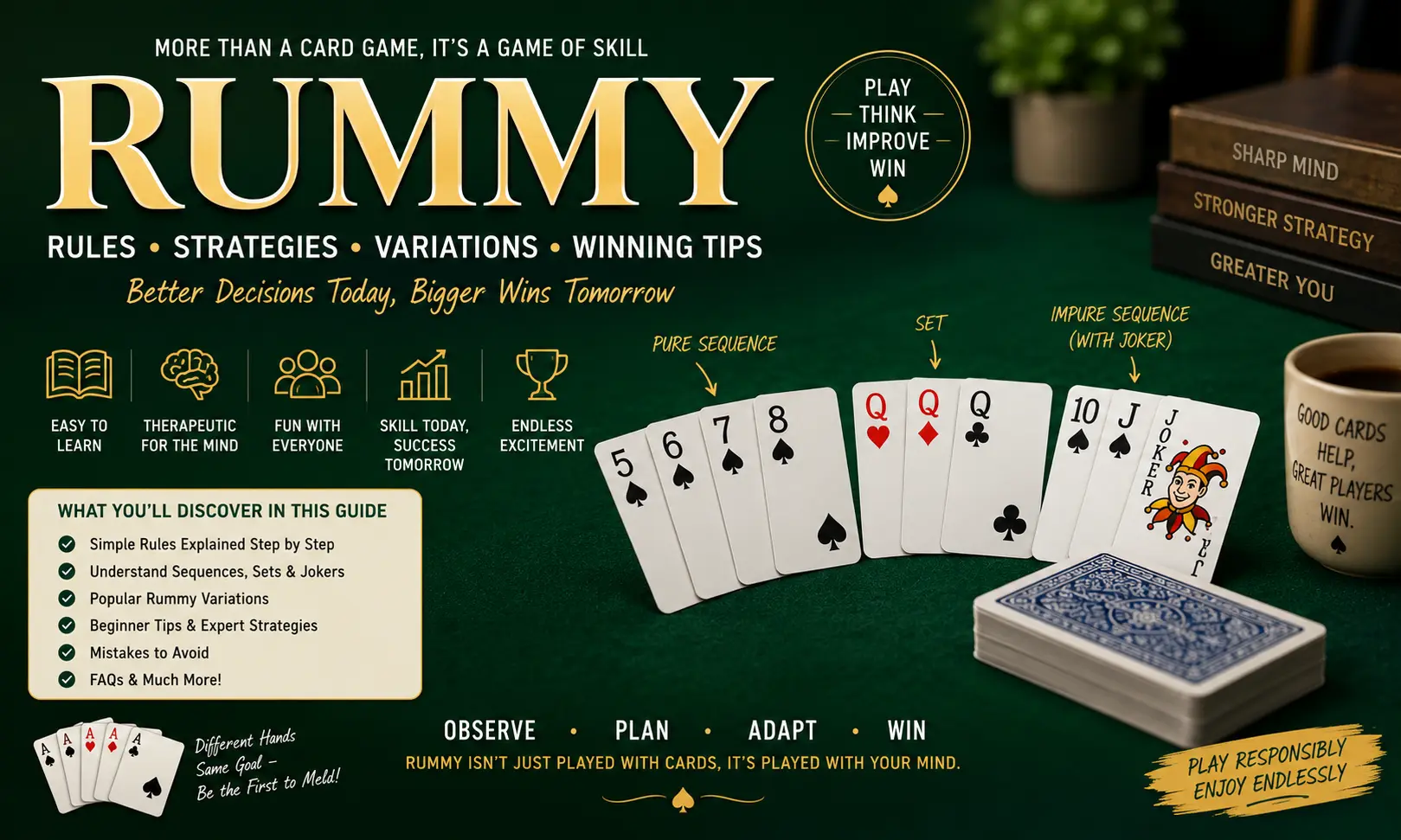
Introduction
Rummy is one of the most popular card games played worldwide. Known for its exciting gameplay, strategic thinking, and skill-based mechanics, rummy has entertained players for generations. Whether played casually with family and friends or competitively in online tournaments, rummy remains a favorite card game among players of all ages.
The primary objective of rummy is simple: arrange your cards into valid sequences and sets before your opponents do. While the rules are easy to understand, mastering the game requires practice, observation, planning, and strategic decision-making.
In recent years, online rummy has transformed the traditional card game experience. Players can now enjoy rummy anytime and anywhere using mobile apps and websites. This accessibility has significantly increased the popularity of the game globally.
In this comprehensive guide, you’ll learn everything about rummy, including its history, rules, gameplay, popular variations, winning strategies, common mistakes, and expert tips.
Table of Contents
- Introduction to Rummy
- What Is Rummy?
- History and Evolution of Rummy
- Why Rummy Is So Popular
- Easy to Learn
- Strategic Gameplay
- Social Entertainment
- Mental Exercise
- Basic Rules of Rummy
- Number of Players
- Deck and Cards Used
- Card Rankings
- Important Rummy Terminology
- Draw
- Discard
- Meld
- Joker
- Sequence
- Set
- Declaration
- Understanding Sequences and Sets
- Pure Sequence
- Impure Sequence
- Valid Set
- How to Play Rummy Step by Step
- Card Distribution
- Joker Selection
- Drawing Cards
- Forming Combinations
- Discarding Cards
- Making a Valid Declaration
- Popular Variations of Rummy
- Indian Rummy
- Points Rummy
- Pool Rummy
- Deals Rummy
- Gin Rummy
- Contract Rummy
- Skills Required to Win at Rummy
- Observation
- Memory
- Patience
- Risk Management
- Decision-Making
- Beginner Tips for Playing Rummy
- Advanced Rummy Strategies
- Bluffing Techniques
- Opponent Tracking
- Card Retention Strategy
- Defensive Gameplay
- Probability Analysis
- Expert Winning Techniques
- Organizing Cards Efficiently
- Building Multiple Possibilities
- Smart Joker Usage
- Reading Opponent Patterns
- Emotional Discipline
- Online Rummy: A Modern Revolution
- Benefits of Online Rummy
- How Online Rummy Works
- Benefits of Playing Rummy
- Improves Memory
- Enhances Concentration
- Develops Analytical Thinking
- Boosts Decision-Making Skills
- Encourages Patience
- Responsible Gaming Practices
- Common Myths About Rummy
- Future of Rummy
- Why Rummy Remains a Timeless Card Game
- Conclusion
- Frequently Asked Questions (FAQs)
What Is Rummy?
Rummy is a card-matching game in which players aim to arrange cards into valid combinations. These combinations generally include:
- Sequences
- Sets
- Pure sequences
- Impure sequences
- all rummy
The game rewards players who can efficiently organize their cards while observing their opponents’ moves.
Unlike many games that rely heavily on luck, rummy involves significant skill. Players must analyze cards, remember discards, predict opponents’ actions, and make strategic decisions throughout the game.
Because of its skill-based nature, rummy has become one of the most respected card games globally.
 Rummy
Rummy
Shiva Ji G| Jun 23, 2026| 14 min read
Rummy Game: The Complete Guide to Rules, Strategies, Variations, and Winning Tips
History of Rummy
The origins of rummy are still debated among historians. Many experts believe the game evolved from a Mexican card game called “Conquian” during the nineteenth century.
Over time, various forms of rummy emerged across different regions. Each version introduced unique rules and gameplay mechanics while retaining the core objective of forming card combinations.
Today, rummy is played in countries across Asia, Europe, North America, and beyond. The game has successfully adapted to digital platforms, making it accessible to millions of online players.
Why Rummy Is So Popular
Easy to Learn
One of the biggest reasons for rummy’s popularity is its simple learning curve. Beginners can understand the basic rules within a short period.
Strategic Gameplay
Rummy is not merely about receiving good cards. Strategic decisions often determine the winner.
Social Entertainment
The game provides an enjoyable way to connect with family and friends.
Mental Exercise
Playing rummy regularly improves concentration, memory, observation skills, and logical thinking.
Multiple Variations
Different versions of rummy keep the game fresh and engaging for players of all experience levels.
Basic Rules of Rummy
Although rules may vary slightly depending on the version being played, the fundamental principles remain the same.
Number of Players
Rummy can be played with:
- 2 players
- 3 players
- 4 players
- 6 players
Some online formats even support larger tables.
Deck Used
Most rummy games use:
- One standard 52-card deck for 2 players
- Two decks with jokers for larger games
- rummy 51
Card Ranking
The card ranking generally follows:
- Ace
- King
- Queen
- Jack
- 10 to 2
In some variations, Ace may function as both a low and high card.
Important Terminology in Rummy
Understanding common rummy terms is essential.
Draw
Taking a card from either the closed deck or discard pile.
Discard
Placing one card into the open pile after completing your turn.
Meld
A valid combination of cards.
Joker
A wild card used to substitute other cards.
Sequence
Three or more consecutive cards of the same suit.
Set
Three or four cards of the same rank but different suits.
Declaration
Showing all valid combinations to end the game.
 Rummy
Rummy
Shiva Ji G| Jun 19, 2026| 14 min read
Best Rummy Game App: Complete Guide to Choosing the Top Rummy Apps in 2026
Understanding Sequences and Sets
Sequences and sets are the foundation of rummy.
Pure Sequence
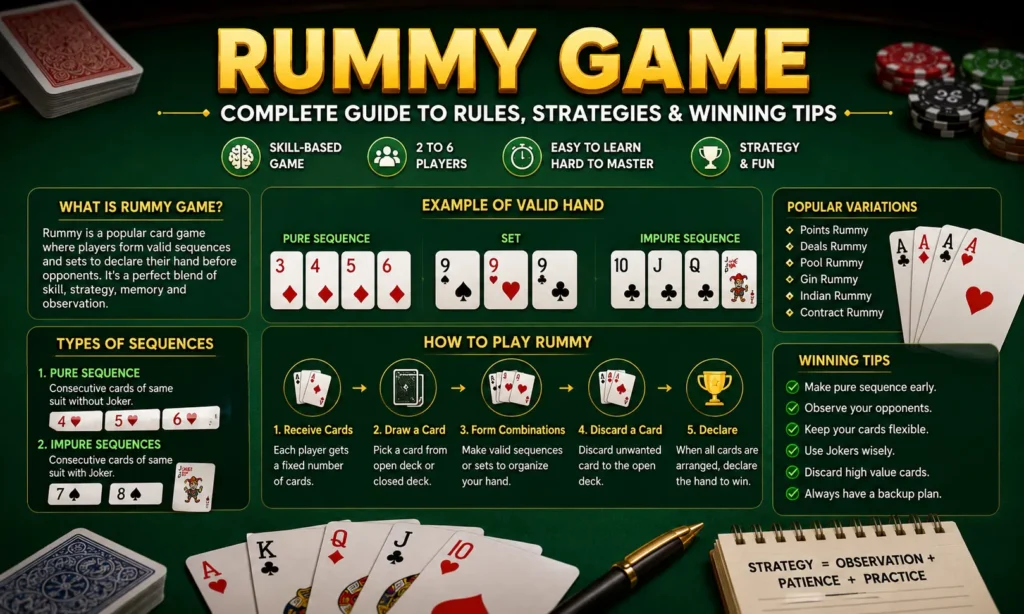
A pure sequence contains consecutive cards of the same suit without any joker.
Example
- 4♥ 5♥ 6♥
This is a valid pure sequence.
A pure sequence is mandatory in most rummy variations.
Impure Sequence
An impure sequence contains one or more jokers.
Example
- 7♣ 8♣ Joker
This forms an impure sequence.
Set
A set consists of cards having the same rank but different suits.
Example
- 9♠ 9♥ 9♣
This forms a valid set.
Duplicate suits are not allowed in a set.
How to Play Rummy Step by Step
Understanding the flow of the game makes learning easier.
Step 1: Deal the Cards
Each player receives a predetermined number of cards.
Usually:
- 13 cards in Indian Rummy
- 10 cards in some international versions
- all rummy apps
Step 2: Choose the Joker
A card is selected randomly to act as the joker.
This card can help complete sets and sequences.
Step 3: Start Drawing Cards
Players take turns drawing one card from either:
- Closed deck
- Open discard pile
Step 4: Form Valid Combinations
The objective is to organize cards into:
- Pure sequences
- Impure sequences
- Sets
Step 5: Discard a Card
After drawing, players must discard one card.
Proper discarding is a critical skill in rummy.
Step 6: Declare
When all cards are arranged into valid combinations, the player declares.
If the declaration is valid, the player wins the game.
Popular Variations of Rummy
One reason for the enduring popularity of rummy is the availability of multiple exciting formats.
Indian Rummy
Indian Rummy is among the most played versions worldwide.
Features
- 13 cards per player
- Two decks used
- Pure sequence required
- Jokers included
- rummy nabob
This version demands considerable strategy and planning.
Points Rummy
Points Rummy is a fast-paced format.
Characteristics
- Single deal
- Quick gameplay
- Winner receives points based on opponents’ scores
Many online players prefer this variation because games finish quickly.
Pool Rummy
Pool Rummy involves multiple rounds.
Key Features
- Elimination-based format
- Accumulated points
- Last remaining player wins
This variation requires long-term strategic thinking.
Deals Rummy
Deals Rummy is played for a fixed number of deals.
Features
- Predetermined rounds
- Equal opportunities
- Lowest score wins
Consistency becomes more important than aggressive gameplay.
Gin Rummy
Gin Rummy is highly popular in Western countries.
Highlights
- Two-player format
- Faster rounds
- Unique scoring system
Many competitive players enjoy its tactical nature.
Contract Rummy
Contract Rummy introduces changing objectives.
Players must complete specific card combinations during each round.
The complexity increases as the game progresses.
 Rummy
Rummy
Shiva Ji G| Jun 19, 2026| 15 min read
Top Rummy Games: The Ultimate Guide to the Best Rummy Games in 2026
Skills Required to Win at Rummy
Rummy is often described as a game of skill.
Observation
Pay attention to cards picked and discarded by opponents.
Observation helps identify their potential combinations.
Memory
Remembering discarded cards provides a significant advantage.
Strong memory skills help predict unavailable cards.
Patience
Successful players avoid rushing decisions.
Patience allows better evaluation of possible combinations.
Risk Management
Sometimes keeping a high-value card can be beneficial.
At other times, discarding it quickly reduces potential losses.
Understanding this balance is essential.
Decision-Making
Every turn presents choices.
Players must decide:
- Which card to draw
- Which card to keep
- Which card to discard
Better decisions often lead to victory.
Beginner Tips for Playing Rummy
New players can improve rapidly by following proven techniques.
Focus on a Pure Sequence First
Always prioritize creating a pure sequence.
Without it, winning becomes impossible in most formats.
Discard High-Value Cards Early
Cards such as:
- King
- Queen
- Jack
- Ace
carry high penalty points.
Discarding unnecessary high-value cards reduces risk.
Use Jokers Wisely
Do not waste jokers on combinations that can easily be completed naturally.
Reserve them for difficult situations.
Observe Opponent Behavior
Watch what other players:
- Pick
- Discard
- Retain
This information can reveal their strategy.
Avoid Frequent Changes
Constantly changing plans often creates confusion.
Stick to a clear strategy whenever possible.
Advanced Rummy Strategies
Experienced players use sophisticated tactics to gain an edge.
Bluffing Through Discards
Sometimes discarding specific cards can mislead opponents about your hand.
Strategic discarding creates uncertainty.
Tracking Opponent Sequences
Analyze every card picked from the discard pile.
This helps identify potential sequences being built.
Card Retention Strategy
Holding useful middle cards like:
- 5
- 6
- 7
- 8
often provides more combination opportunities.
These cards are highly flexible.
Defensive Play
Prevent opponents from completing combinations.
Avoid discarding cards they are likely waiting for.
Probability Analysis
Expert players estimate the likelihood of drawing needed cards.
This improves decision-making significantly.
 Rummy
Rummy
Shiva Ji G| Jun 19, 2026| 16 min read
Top 20 Rummy 51 Bonus: Complete Guide to the Best Rummy Bonuses, Offers, and Winning Strategies in 2026
Common Mistakes to Avoid
Even experienced players occasionally make costly errors.
Ignoring Pure Sequences
Failing to prioritize a pure sequence often results in invalid declarations.
Holding High Cards Too Long
This can increase penalty points dramatically.
Misusing Jokers
Poor joker management reduces strategic flexibility.
Poor Observation
Ignoring opponents’ moves eliminates valuable information.
Rushing Declarations
An incorrect declaration usually results in heavy penalties.
Carefully verify all combinations before declaring.
Rummy: The Complete Guide to Rules, Strategies, Variations, and Winning Tips
Rummy: The Complete Guide to Rules, Strategies, Variations, and Winning Tips
Expert Winning Techniques in Rummy
Mastering rummy requires more than understanding the rules. Successful players consistently apply advanced strategies that maximize their winning chances.
Prioritize Card Organization
One habit shared by experienced players is organizing cards immediately after receiving them.
Benefits include:
- Faster decision-making
- Better visualization of sequences
- Reduced chances of mistakes
- Improved hand management
- top rummy
A well-organized hand helps identify opportunities quickly.
Build Multiple Possibilities
Instead of focusing on a single sequence, create multiple potential combinations.
Example
If you have:
- 5♠
- 6♠
- 7♠
- 7♦
You can work toward several combinations simultaneously.
This flexibility increases your chances of completing valid sets and sequences.
Keep an Eye on Jokers
Jokers are among the most valuable cards in rummy.
However, expert players do not become overly dependent on them.
Smart Joker Usage
Use jokers to:
- Complete difficult sequences
- Finish high-value combinations
- Reduce risk during critical stages
Avoid wasting jokers on combinations that can easily be completed naturally.
Learn Opponent Patterns
Every player develops habits.
Some players:
- Prefer collecting middle cards
- Focus on sets
- Chase long sequences
- Discard high cards early
Recognizing these patterns can provide a significant competitive advantage.
Maintain Emotional Discipline
One of the most underrated skills in rummy is emotional control.
Winning players remain calm whether:
- Receiving poor cards
- Losing multiple rounds
- Facing strong opponents
Emotional decisions often lead to costly mistakes.
 Rummy
Rummy
Shiva Ji G| Jun 19, 2026| 15 min read
Best Rummy Games: The Ultimate Guide to Playing, Winning, and Choosing the Right Rummy Game in 2026
Online Rummy: A Modern Revolution
The rise of digital platforms has transformed how people enjoy rummy.
Today, millions of players participate in online rummy games every day.
Advantages of Online Rummy
Convenience
Players can enjoy games anytime and anywhere.
Variety
Online platforms offer:
- Points Rummy
- Pool Rummy
- Deals Rummy
- Gin Rummy
- Tournament Formats
Skill Development
Playing regularly against diverse opponents improves overall gameplay.
Practice Opportunities
Many platforms provide free practice tables for beginners.
How Online Rummy Works
The process is straightforward.
Registration
Create an account on a trusted platform.
Select a Game Format
Choose from available rummy variations.
Join a Table
Enter a game according to your preferred skill level.
Start Playing
Arrange cards, create combinations, and declare before opponents.
Benefits of Playing Rummy
Rummy is not only entertaining but also beneficial for mental development.
Improves Memory
Players constantly track:
- Discards
- Picked cards
- Opponent behavior
This strengthens memory retention.
Enhances Concentration
A single missed observation can affect the outcome.
Regular gameplay improves focus and attention span.
Develops Analytical Thinking
Rummy encourages players to:
- Analyze probabilities
- Evaluate risks
- Predict outcomes
These skills are useful beyond the game itself.
Boosts Decision-Making Skills
Every turn requires strategic choices.
Frequent gameplay enhances decision-making under pressure.
Encourages Patience
Successful players understand that not every hand can be won immediately.
Patience often produces better long-term results.
Responsible Gaming Practices
Although rummy is an enjoyable skill-based game, maintaining balance is important.
Set Time Limits
Avoid excessive gameplay sessions.
Establish a schedule and stick to it.
Play Within Your Comfort Zone
Choose game formats that match your experience level.
Gradual progression helps build confidence.
Take Regular Breaks
Short breaks improve focus and prevent mental fatigue.
Focus on Skill Development
View each game as an opportunity to improve rather than merely win.
Maintain Healthy Gaming Habits
Balance gaming with:
- Work
- Education
- Exercise
- Family activities
Healthy habits contribute to better performance.
Common Myths About Rummy
Many misconceptions exist about rummy.
Let’s address some of the most common myths.
Myth 1: Rummy Is Purely Luck-Based
Reality:
While card distribution involves chance, long-term success depends heavily on skill, strategy, and decision-making.
Myth 2: Jokers Guarantee Victory
Reality:
Jokers help but cannot replace sound strategy.
Poor decision-making can waste even the strongest hands.
Myth 3: Beginners Cannot Win
Reality:
New players often succeed by following basic principles and avoiding common mistakes.
Myth 4: Memorizing Cards Is Impossible
Reality:
With practice, players naturally improve their card-tracking abilities.
Myth 5: Aggressive Play Always Wins
Reality:
Balanced and calculated gameplay generally produces better results.
Future of Rummy
The popularity of rummy continues to grow worldwide.
Several factors are driving this expansion.
Mobile Gaming Growth
Smartphones have made rummy accessible to millions of new players.
Improved Technology
Modern platforms now offer:
- Better graphics
- Faster gameplay
- Enhanced security
- Advanced matchmaking systems
Global Player Communities
Players from different countries can now compete against one another.
This creates a more exciting and competitive environment.
Skill-Based Competition
Competitive tournaments continue attracting players who enjoy strategic challenges.
 Rummy
Rummy
Shiva Ji G| Jun 19, 2026| 15 min read
Top Rummy: The Ultimate Guide to Mastering Online Rummy in 2026
Why Rummy Remains a Timeless Card Game
Few card games have maintained relevance across generations as successfully as rummy.
Its continued popularity comes from several strengths:
Simplicity
Anyone can learn the basics quickly.
Strategic Depth
Advanced players constantly discover new tactics.
Social Interaction
The game encourages communication and friendly competition.
Mental Engagement
Every round presents fresh challenges.
Endless Variety
Multiple versions keep gameplay exciting and rewarding.
These qualities ensure that rummy remains a favorite card game for years to come.
Conclusion
Rummy is much more than a simple card game. It is a fascinating blend of skill, observation, patience, memory, and strategy. Whether played casually with friends or competitively online, rummy provides endless entertainment while sharpening important cognitive abilities.
Beginners can quickly learn the rules and enjoy the excitement of creating sequences and sets. Experienced players can explore advanced tactics, probability analysis, and strategic gameplay to improve their winning potential.
The game’s flexibility, accessibility, and strategic depth have helped it remain one of the world’s most beloved card games. As online platforms continue to evolve, the future of rummy looks brighter than ever.
If you are new to the game, start with the fundamentals, practice regularly, and gradually develop advanced skills. With dedication and patience, you can become a confident and successful rummy player.
Frequently Asked Questions (FAQs)
Rummy is a skill-based card game that involves arranging cards into valid sequences and sets. The primary objective is to organize all the cards in your hand into proper combinations before your opponents do. The game is played using one or two standard decks of cards, depending on the variation. Over the years, rummy has become one of the most widely played card games because it combines entertainment with strategic thinking.
One reason for its popularity is that the rules are relatively easy to learn. Beginners can understand the basics within a short period, while experienced players can spend years mastering advanced strategies. Rummy also appeals to players because every game is different. Card distribution changes in each round, requiring players to adapt their tactics constantly.
Additionally, rummy helps improve memory, concentration, observation skills, and decision-making abilities. Whether played casually with friends or competitively online, rummy offers an engaging experience that keeps players coming back. Its perfect balance of luck and skill has helped it remain a favorite card game across generations and cultures.
Learning how to play rummy is straightforward once you understand the basic rules. At the beginning of the game, each player receives a specific number of cards. The remaining cards form a draw pile, and one card is placed face-up to start the discard pile. Players take turns drawing a card and discarding one card from their hand.
The goal is to arrange cards into valid combinations known as sequences and sets. A sequence consists of three or more consecutive cards of the same suit, while a set contains cards of the same rank but different suits. In many versions of rummy, forming at least one pure sequence is mandatory before declaring a win.
Beginners should focus first on creating a pure sequence because it is the foundation of a valid hand. It is also important to discard unnecessary high-value cards such as Kings, Queens, Jacks, and Aces when they do not contribute to potential combinations. Observing opponents and tracking discarded cards can provide valuable information about which cards are likely to be available.
With regular practice, beginners quickly become comfortable identifying useful combinations and making strategic decisions throughout the game.
Winning at rummy requires more than receiving good cards. Successful players rely on a combination of observation, planning, and smart decision-making. One of the most important strategies is prioritizing the formation of a pure sequence early in the game. Without a pure sequence, a declaration is usually invalid.
Another key strategy involves managing high-value cards carefully. Holding cards such as Kings, Queens, Jacks, and Aces for too long can result in heavy penalty points if an opponent declares first. Therefore, players should discard unnecessary high cards whenever possible.
Jokers are powerful tools and should be used wisely. Instead of using them to complete easy combinations, experienced players reserve jokers for difficult sequences or critical sets. Observing opponents is equally important. Watching which cards they pick up or discard can reveal the combinations they are trying to build.
Strong memory skills can also improve performance. Remembering discarded cards helps players avoid chasing unavailable combinations. Finally, maintaining flexibility is crucial. Rather than depending on a single plan, successful players keep multiple combination possibilities open, allowing them to adapt as the game progresses.
Rummy has evolved into several popular variations, each offering unique gameplay experiences. One of the most well-known versions is Indian Rummy, which is typically played with 13 cards and requires at least one pure sequence for a valid declaration. This version is especially popular among online players.
Points Rummy is another common format. It is fast-paced and usually consists of a single deal. The winner receives points based on opponents’ scores, making it ideal for players who prefer quick games.
Pool Rummy is a longer format where players accumulate points over multiple rounds. Participants are eliminated after reaching a predetermined point limit, and the last remaining player wins. Deals Rummy, on the other hand, is played for a fixed number of deals, with the player having the lowest total score declared the winner.
Gin Rummy is highly popular in Western countries and is generally played between two players. It features a unique scoring system and faster gameplay. Contract Rummy introduces changing objectives during different rounds, adding an extra layer of complexity. Each variation provides a distinct challenge, allowing players to choose the format that best suits their preferences and skill level.
Improving at rummy requires dedication, practice, and a willingness to learn from experience. The first step is developing a strong understanding of the game’s rules and card combinations. Players should become comfortable identifying sequences, sets, pure sequences, and joker opportunities quickly.
Regular practice is one of the most effective ways to enhance performance. The more games you play, the better you become at recognizing patterns and making strategic decisions. Reviewing past games can also be beneficial because it helps identify mistakes and areas for improvement.
Observation plays a major role in skill development. Successful players pay close attention to opponents’ actions, including which cards they pick and discard. This information helps predict their strategies and avoid helping them complete combinations.
Learning probability is another useful skill. Understanding the likelihood of drawing specific cards can improve decision-making and reduce unnecessary risks. Additionally, maintaining emotional discipline is important. Avoid making impulsive moves after receiving poor cards or losing a few rounds.
Finally, stay patient and focus on long-term improvement rather than immediate results. With consistent effort, smart practice, and strategic thinking, any player can significantly improve their rummy skills and increase their chances of winning.
Leave a Reply