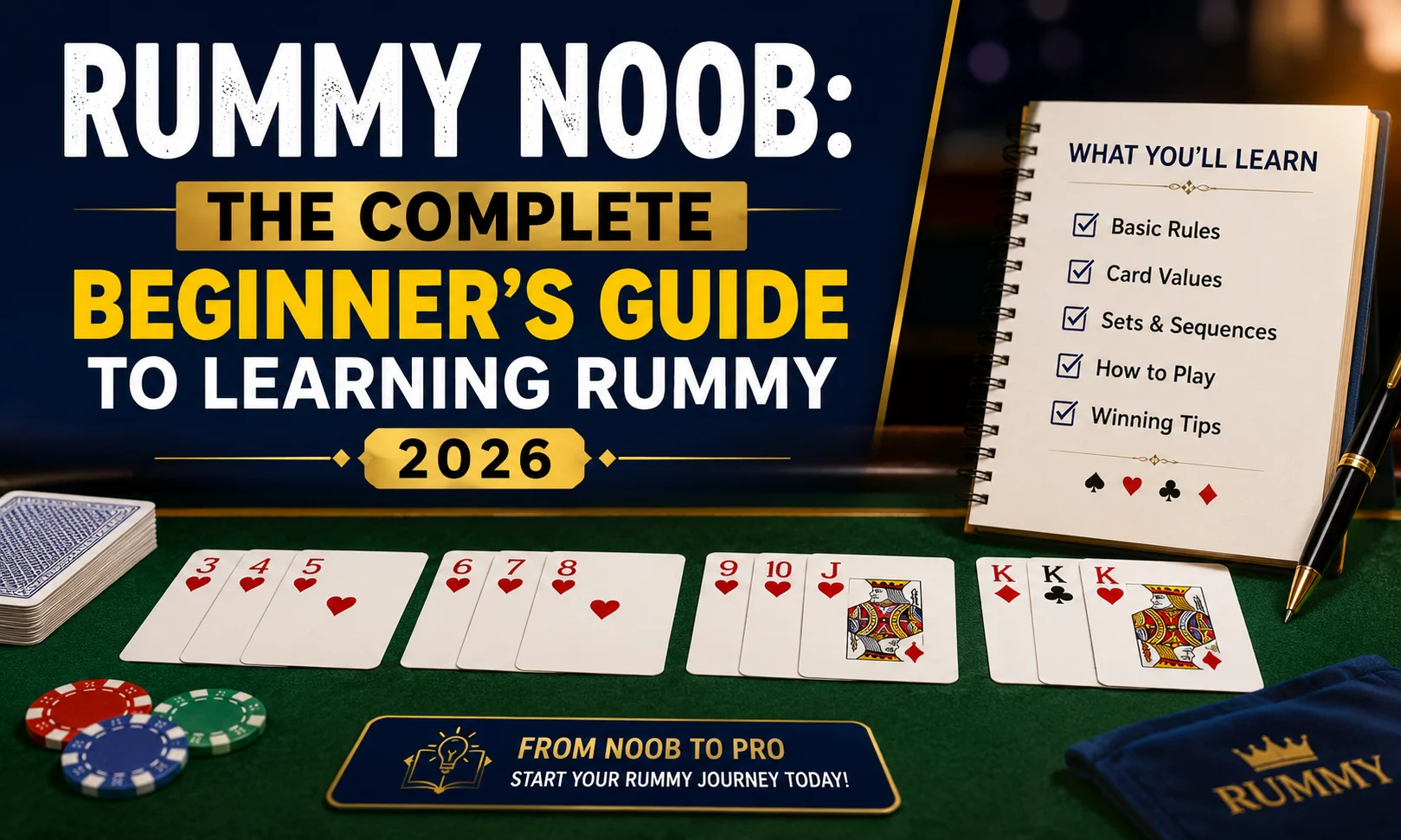
Introduction
Rummy is one of the world’s most popular card games, enjoyed by millions of players across different countries and cultures. It is a game that combines strategy, observation, logical thinking, and decision-making, making it both entertaining and intellectually engaging. Whether you’re playing with friends, family, or in a casual card club, understanding the fundamentals of rummy can greatly enhance your enjoyment of the game.
If you’re completely new to rummy, don’t worry—every experienced player started as a beginner. This comprehensive Rummy Noob Guide (2026) is designed specifically for newcomers who want to learn the game from scratch. Instead of assuming prior knowledge, this guide explains the essential rules, card combinations, gameplay mechanics, and beginner-friendly strategies in clear and simple language.
Throughout this guide, you’ll discover how to build valid sequences and sets, organize your cards efficiently, avoid common beginner mistakes, and develop the confidence to make better decisions during each game. You’ll also learn practical tips for improving your observation skills, managing your hand effectively, and understanding the strategic elements that make rummy more than just a game of chance.
Whether your goal is to enjoy casual games with friends or simply understand how traditional rummy works, this guide will give you a strong foundation. By the end, you’ll have the knowledge needed to play with confidence, continue improving your skills, and appreciate why rummy has remained one of the most beloved card games for generations.
Table of Contents
- Introduction to Rummy Noob
- What Is Rummy?
- Why Rummy Is Popular in 2026
- Who Should Read This Beginner’s Guide?
- Understanding the Basics of Rummy
- Objective of the Game
- Number of Players
- Standard Deck of Cards
- Rummy Card Values Explained
- Essential Rummy Terms Every Beginner Should Know
- How to Play Rummy: Step-by-Step Guide
- Dealing the Cards
- Drawing a Card
- Forming Sequences and Sets
- Discarding a Card
- Declaring Your Hand
- Types of Sequences in Rummy
- Pure Sequence
- Impure Sequence
- Understanding Sets in Rummy
- Basic Rummy Rules for Beginners
- Common Mistakes Every Rummy Noob Should Avoid
- Easy Tips to Improve Your Rummy Skills
- Winning Strategies for New Players
- How to Practice Rummy Effectively
- Different Variations of Rummy
- Points Rummy
- Pool Rummy
- Deals Rummy
- Indian Rummy
- Gin Rummy
- Rummy Etiquette and Fair Play
- Responsible Gaming Tips
- Conclusion
- Frequently Asked Questions (FAQs)
What Does “Rummy Noob” Mean?
A rummy noob is simply someone who is new to the game. Beginners often wonder:
- What is a sequence?
- How do I win?
- Which cards should I keep?
- Which cards should I discard?
- What mistakes should I avoid?
These are completely normal questions. Learning rummy doesn’t require years of experience—it requires patience, observation, and regular practice.
The good news is that once you understand the basic concepts, the game becomes much easier to enjoy.

Top Rummy: The Ultimate Guide to the Best Online Rummy Platforms in 2026
The History of Rummy
Rummy belongs to one of the largest families of matching-card games in the world.
Although historians disagree on its exact origin, many believe modern rummy evolved from older matching games played in Europe and Asia during the 18th and 19th centuries.
Over time, several variations emerged, including:
- Classic Rummy
- Gin Rummy
- Indian Rummy
- Contract Rummy
- Canasta
- Oklahoma Rummy
Today, millions of people enjoy rummy both casually with friends and in organized competitions around the world.
Why Rummy Is Popular Worldwide
Unlike games that rely heavily on luck, rummy rewards thoughtful decision-making and careful observation.
Many players enjoy rummy because it combines:
- Strategy
- Planning
- Memory
- Pattern recognition
- Decision-making
Every game is different, which keeps the experience fresh and engaging.
Players also appreciate that the rules are relatively simple to learn, making rummy accessible to beginners while still offering depth for experienced players.
Understanding the Objective of Rummy
The primary goal of rummy is to organize your cards into valid combinations before your opponents do.
These combinations usually include:
- Sequences (cards in consecutive order of the same suit)
- Sets (cards of the same rank but different suits)
A player wins by arranging all their cards into valid combinations according to the rules of the variation being played.
Success depends on making good decisions about which cards to keep and which to discard.
Basic Terminology Every Beginner Should Know
Before playing, it’s important to understand common rummy terms.
Deck
A standard pack of 52 playing cards.
Suit
There are four suits:
- Hearts ♥
- Diamonds ♦
- Clubs ♣
- Spades ♠
Rank
Cards are ranked:
A, 2, 3, 4, 5, 6, 7, 8, 9, 10, J, Q, K
Draw
Taking one card from either the draw pile or discard pile.
Discard
Placing one unwanted card into the discard pile.
Meld
A valid group of cards forming a sequence or set.
Sequence
Three or more consecutive cards of the same suit.
Example:
5♥ 6♥ 7♥
Set
Three or four cards of the same rank in different suits.
Example:
9♠ 9♥ 9♦
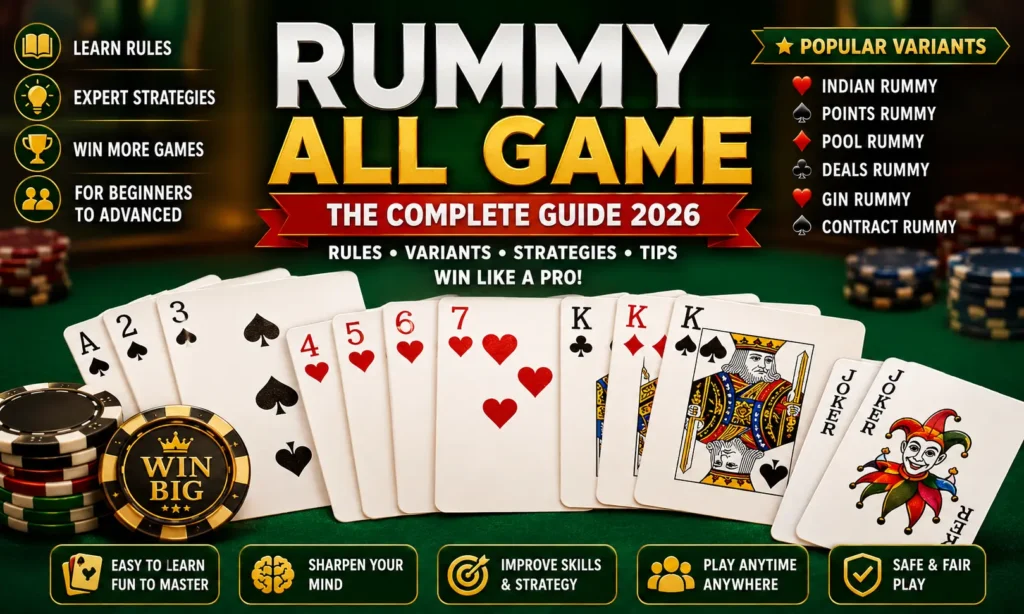
Rummy All Game: The Ultimate Guide to Every Rummy Variant in 2026
Types of Rummy Games
There are many versions of rummy played across the world.
Classic Rummy
The original version with straightforward rules.
Gin Rummy
Usually played between two players and emphasizes quick decision-making.
Indian Rummy
A popular variation that uses two decks and has specific sequence requirements.
Contract Rummy
Players complete different objectives in each round.
Canasta
A partnership game using multiple decks and special scoring rules.
Each variation has unique rules, but all share the core objective of forming valid card combinations.
Standard Deck of Cards Explained
Most rummy games use a standard deck containing:
- 52 cards
- 4 suits
- 13 cards in each suit
Some variations use:
- Two decks
- Jokers
- Wild cards
Understanding the deck helps beginners identify potential sequences and sets more quickly.
Card Rankings and Values
Knowing card values is essential.
| Card | Value |
|---|---|
| Ace | Can be low or high depending on rules |
| 2–10 | Face value |
| Jack | 10 points |
| Queen | 10 points |
| King | 10 points |
Different rummy variants may calculate scores differently, so it’s always helpful to review the rules before playing.
How a Typical Rummy Game Works
Although variations exist, the basic flow of a game is similar.
Step 1
Cards are shuffled.
Step 2
Each player receives a fixed number of cards.
Step 3
The remaining cards form the draw pile.
Step 4
One card starts the discard pile.
Step 5
Players take turns:
- Draw one card.
- Organize their hand.
- Discard one card.
The cycle continues until a player successfully arranges all cards into valid combinations.
Rules Every Beginner Must Learn
Before attempting advanced strategies, focus on these fundamental rules:
- Draw only one card per turn.
- Discard exactly one card after drawing.
- Build valid sequences and sets.
- Avoid keeping unnecessary high-value cards for too long.
- Pay attention to the cards your opponents discard and pick up.
- Organize your hand regularly to spot opportunities.
Following these rules consistently will help you develop good habits early.
Step-by-Step Guide to Playing Rummy
Imagine you’re dealt the following cards:
3♥, 4♥, 5♥, 8♣, 8♦, 8♠, J♠, Q♠, K♠
You can immediately identify:
Sequence:
3♥ 4♥ 5♥
Set:
8♣ 8♦ 8♠
Another sequence:
J♠ Q♠ K♠
Recognizing these combinations quickly makes it easier to plan your next moves.
How to Arrange Your Cards Efficiently
Good organization helps prevent mistakes.
A simple method is to separate your cards into:
Confirmed Sequences
Already completed.
Possible Sequences
Need one additional card.
Confirmed Sets
Already completed.
Unmatched Cards
Cards that currently don’t fit into any combination.
This approach allows you to evaluate your options at a glance.
Difference Between Sequence and Set
Many beginners confuse these two concepts.
Sequence
Cards must:
- Be consecutive.
- Belong to the same suit.
Example:
7♣ 8♣ 9♣
Set
Cards must:
- Have the same rank.
- Belong to different suits.
Example:
K♥ K♦ K♠
Understanding this distinction is one of the most important steps in learning rummy.
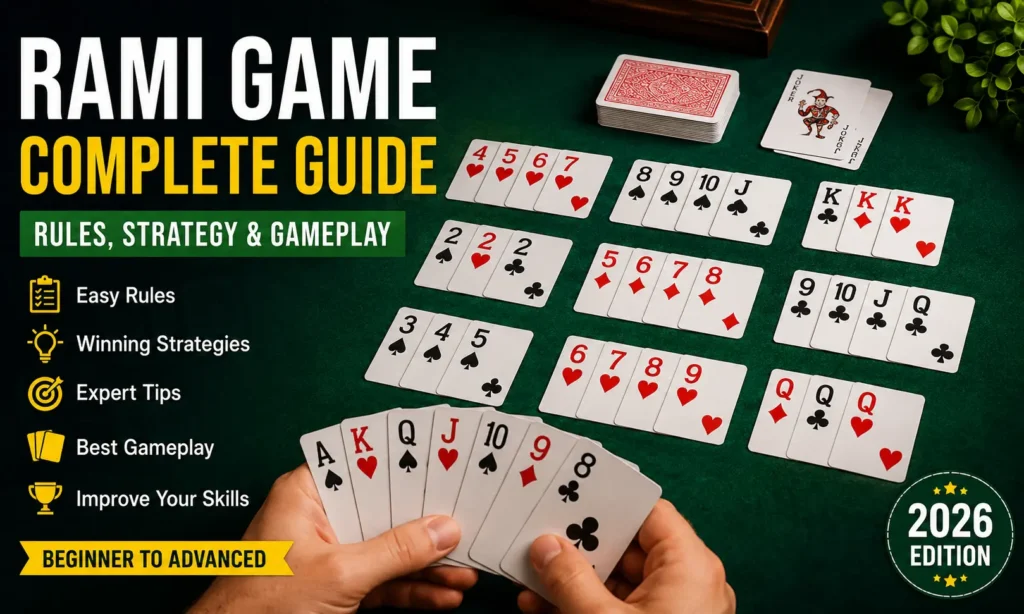
Rami Game: The Complete Beginner’s Guide to Rules, Strategy & Gameplay (2026)
Common Mistakes Beginners Make
Most new players repeat similar errors.
Keeping Too Many High Cards
High cards can increase your score if left unmatched.
Ignoring Opponent Behavior
Watching which cards opponents draw or discard can provide useful clues.
Breaking Good Combinations
Avoid dismantling completed sequences or sets unless the rules of your game make it advantageous.
Holding Every Card
Not every card will help you. Learn to let go of cards that don’t contribute to your strategy.
Playing Too Quickly
Take a moment to evaluate your hand before every move.
Beginner Tips to Improve Faster
Developing good habits early can make learning easier.
- Practice regularly with friends or training games.
- Review completed games to identify mistakes.
- Memorize common sequences.
- Observe experienced players.
- Focus on building valid combinations first.
- Stay patient—improvement comes with practice.
- Keep your cards organized throughout the game.
- Learn one variation thoroughly before trying others.
- Think ahead rather than reacting only to your current hand.
- Enjoy the learning process and don’t be discouraged by early losses.
Intermediate Rummy Strategies
Once you’ve mastered the basics, the next step is improving your decision-making. Winning consistently isn’t about luck—it’s about making smart choices throughout the game.
Build Combinations Early
Whenever possible, complete a sequence before trying to form multiple sets. A completed combination gives you a solid foundation and makes the rest of your hand easier to organize.
Avoid Holding Too Many High Cards
High-value face cards (J, Q, K) are useful if they fit into a sequence, but if they don’t, consider discarding them rather than waiting too long.
Stay Flexible
Don’t become attached to one plan. If the cards you need don’t appear, adapt your strategy and work with the cards you have.
Advanced Decision-Making
Experienced players constantly evaluate every move.
Before drawing or discarding, ask yourself:
- Does this card help complete a sequence?
- Could this card help an opponent?
- Am I holding unnecessary cards?
- What combinations are closest to completion?
- Is there a safer discard available?
Making thoughtful decisions each turn leads to stronger overall play.
Reading Your Opponents
One of the biggest differences between beginners and experienced players is observation.
Pay attention to:
- Which cards opponents pick up.
- Which cards they ignore.
- What they discard repeatedly.
- Whether they’re building sequences or sets.
For example, if an opponent picks up 7♥ and later 8♥, avoid discarding 6♥ or 9♥, as those cards may help them complete a sequence.
Card Tracking and Memory Techniques
You don’t need to memorize every card. Instead, focus on the most important information.
Watch the Discard Pile
The discard pile reveals which cards are unlikely to be useful to other players.
Remember Key Cards
Keep track of:
- Cards you’ve discarded.
- Cards opponents have taken.
- Cards that would complete your combinations.
With practice, your memory naturally improves.
Hand Management
Keeping your hand organized reduces mistakes.
A simple method is to divide your cards into:
- Completed sequences
- Completed sets
- Potential sequences
- Potential sets
- Unmatched cards
Rearranging your hand after every turn helps you spot opportunities quickly.
Defensive Play
Rummy isn’t just about improving your own hand—it’s also about avoiding moves that help your opponents.
Think Before You Discard
Before discarding a card, consider whether it could easily complete a sequence or set for another player.
Observe Patterns
If an opponent consistently collects cards of one suit, avoid discarding nearby cards in that suit.
Improving Through Practice
Practice is the fastest way to improve.
Here are some effective methods:
Play Friendly Games
Playing with friends or family helps you gain experience in a relaxed environment.
Review Your Games
After each game, think about:
- Which decisions worked?
- Which mistakes cost you?
- What could you do differently next time?
Learn One Variation First
Instead of switching between many versions, master one before exploring others.

Rummy All: The Complete Guide to Playing, Winning, and Choosing the Best Rummy Apps in 2026
Common Myths About Rummy
Myth 1: Winning Is Pure Luck
While the cards you receive involve chance, your decisions throughout the game have a significant impact on the outcome.
Myth 2: Good Players Memorize Every Card
Most experienced players remember only the most relevant cards and patterns rather than every card played.
Myth 3: Aggressive Play Always Wins
Sometimes patience and careful planning are more effective than taking unnecessary risks.
Myth 4: Beginners Can’t Beat Experienced Players
A beginner who follows the rules carefully and makes thoughtful decisions can still perform well.
Winning Habits of Experienced Players
Successful players often share similar habits:
- They stay calm under pressure.
- They organize their cards consistently.
- They observe opponents closely.
- They adapt to changing situations.
- They avoid unnecessary risks.
- They review their mistakes after each game.
- They focus on long-term improvement rather than individual wins or losses.
Developing these habits over time can make a noticeable difference in your gameplay.
Rummy Etiquette
Whether you’re playing casually with friends or in a club, good sportsmanship matters.
Remember to:
- Follow the agreed-upon rules.
- Take your turns promptly.
- Avoid revealing your cards unnecessarily.
- Respect other players.
- Accept wins and losses gracefully.
A positive attitude makes the game more enjoyable for everyone.
Mistakes to Avoid
Even experienced players occasionally make errors. Here are some common ones:
- Ignoring completed combinations while chasing unlikely ones.
- Holding onto cards that no longer fit your strategy.
- Discarding cards without considering how they might help opponents.
- Playing too quickly without reviewing your hand.
- Becoming frustrated after a setback and making rushed decisions.
Recognizing these mistakes is the first step toward avoiding them.
How to Continue Improving
If you want to keep getting better:
- Practice regularly.
- Study different rummy variations.
- Watch experienced players.
- Analyze your own games.
- Challenge players with different styles.
- Learn from both victories and defeats.
Improvement comes gradually through experience and reflection.
Final Thoughts
Learning rummy is a journey that rewards patience, practice, and thoughtful decision-making. While every game begins with a random hand of cards, the choices you make throughout the game—how you organize your cards, which ones you keep or discard, and how well you observe the table—can significantly influence your performance. This blend of skill and strategy is what has made rummy a timeless card game enjoyed by players around the world.
As a beginner, don’t worry about winning every game. Instead, focus on understanding the core concepts, recognizing card patterns, and improving your decision-making with each round you play. Every match provides an opportunity to learn something new, whether it’s identifying a better sequence, managing your hand more efficiently, or avoiding a common mistake. Over time, these small improvements add up and help build confidence.
One of the best ways to improve is to practice regularly in a friendly, casual environment where you can experiment with different strategies without pressure. Watching experienced players, reviewing your own decisions after each game, and staying open to learning will help you develop a deeper understanding of the game. Remember that even highly skilled players continue refining their techniques over time.
Most importantly, enjoy the experience. Rummy is not just about forming card combinations—it’s about strategic thinking, adapting to changing situations, and sharing enjoyable moments with others. Whether you’re playing for fun at home or participating in a friendly competition, approaching the game with a positive attitude and a willingness to learn will make it far more rewarding.
As you continue your journey, you’ll gradually move from being a “rummy noob” to a confident and capable player. Keep practicing, stay patient, and remember that every great player once started exactly where you are today.
Conclusion
Rummy is a classic card game that combines skill, strategy, observation, and careful planning. Although it may seem challenging at first, the fundamentals are straightforward once you understand the basic rules, card combinations, and gameplay. As a beginner, your focus should be on learning how to create valid sequences and sets, organizing your hand efficiently, and making thoughtful decisions during every turn.
Throughout this guide, we’ve explored everything a new player needs to know—from understanding the objective of the game and learning essential terminology to applying practical strategies and avoiding common beginner mistakes. These foundational skills will help you become more confident and consistent each time you play.
Remember that becoming a skilled rummy player doesn’t happen overnight. Improvement comes through regular practice, observing experienced players, reviewing your own gameplay, and learning from both victories and defeats. Every game provides valuable experience that strengthens your strategic thinking and decision-making abilities.
Most importantly, approach rummy as an enjoyable and engaging card game. Focus on improving your skills, thinking ahead, and making smart choices rather than worrying about immediate results. With patience, dedication, and continuous learning, you’ll steadily grow from a beginner into a confident and capable player.
We hope this Rummy Noob Guide (2026) has given you a solid foundation to start your journey. Keep practicing, enjoy the challenge, and have fun exploring the many strategic possibilities that make rummy one of the most popular card games in the world.
Frequently Asked Questions (FAQs)
Rummy is a popular card game in which players aim to arrange their cards into valid combinations, such as sequences (cards of the same suit in consecutive order) and sets (cards of the same rank but different suits). The exact rules may vary depending on the version being played, but the core objective remains the same. One of the reasons rummy has remained popular for generations is that it is relatively easy to learn while offering plenty of strategic depth. Beginners can understand the basic gameplay after just a few rounds, especially if they focus on learning the rules step by step. Rather than trying to master advanced strategies immediately, new players should practice recognizing card combinations, organizing their hand effectively, and making careful decisions about which cards to keep or discard. With regular practice and patience, beginners can quickly build confidence and enjoy the game.
Understanding the difference between a sequence and a set is one of the most important parts of learning rummy. A sequence is made up of three or more consecutive cards of the same suit. For example, 5♥, 6♥, and 7♥ form a valid sequence because the cards are in numerical order and belong to the same suit. A set, on the other hand, consists of three or four cards of the same rank but from different suits. For example, 9♠, 9♥, and 9♦ create a valid set. Confusing these two combinations is a common beginner mistake, so practicing with sample hands can help you recognize them more quickly. Once you can easily identify sequences and sets, you’ll be able to organize your cards more efficiently and make better strategic decisions during gameplay.
Many new players make similar mistakes when they first learn rummy. One common error is holding on to high-value cards for too long, hoping they will eventually fit into a combination. If those cards remain unmatched, they can become a disadvantage. Another mistake is failing to organize the hand properly, making it difficult to spot possible sequences or sets. Beginners also tend to ignore the cards that other players draw or discard, missing valuable clues about their opponents’ strategies. Some players rush their decisions without carefully evaluating their options, while others become too focused on completing a single combination and overlook better opportunities elsewhere in their hand. The best way to avoid these mistakes is to stay patient, review your hand after every turn, and think about both your own strategy and the possible intentions of your opponents.
Improving at rummy requires consistent practice and a willingness to learn from every game. Start by mastering the basic rules and becoming comfortable with identifying sequences and sets. Keep your cards organized throughout the game so you can quickly recognize possible combinations. Pay close attention to the discard pile and observe the cards your opponents choose to pick up or discard, as this information can help you make smarter decisions. After each game, take a few moments to think about what worked well and what could have been done differently. Watching experienced players, reading strategy guides, and practicing regularly with friends or family can also accelerate your progress. Remember that becoming skilled at rummy is a gradual process, and every game provides an opportunity to improve your strategic thinking, observation, and decision-making abilities.
Rummy includes both chance and skill, but skill plays a major role over time. The cards you receive at the beginning of a game are random, which introduces an element of luck. However, how you use those cards depends entirely on your decisions. Skilled players carefully plan their moves, observe opponents, manage their hands efficiently, and adapt their strategy as the game progresses. They know when to keep a card, when to discard it, and how to recognize the best opportunities for forming valid combinations. Beginners may sometimes win due to a favorable hand, but experienced players generally achieve better long-term results because of their knowledge and decision-making. This balance between luck and strategy is one of the reasons rummy remains an engaging and enjoyable card game for players of all experience levels. By practicing regularly and learning from each game, anyone can develop the skills needed to become a more confident and capable rummy player.
Leave a Reply