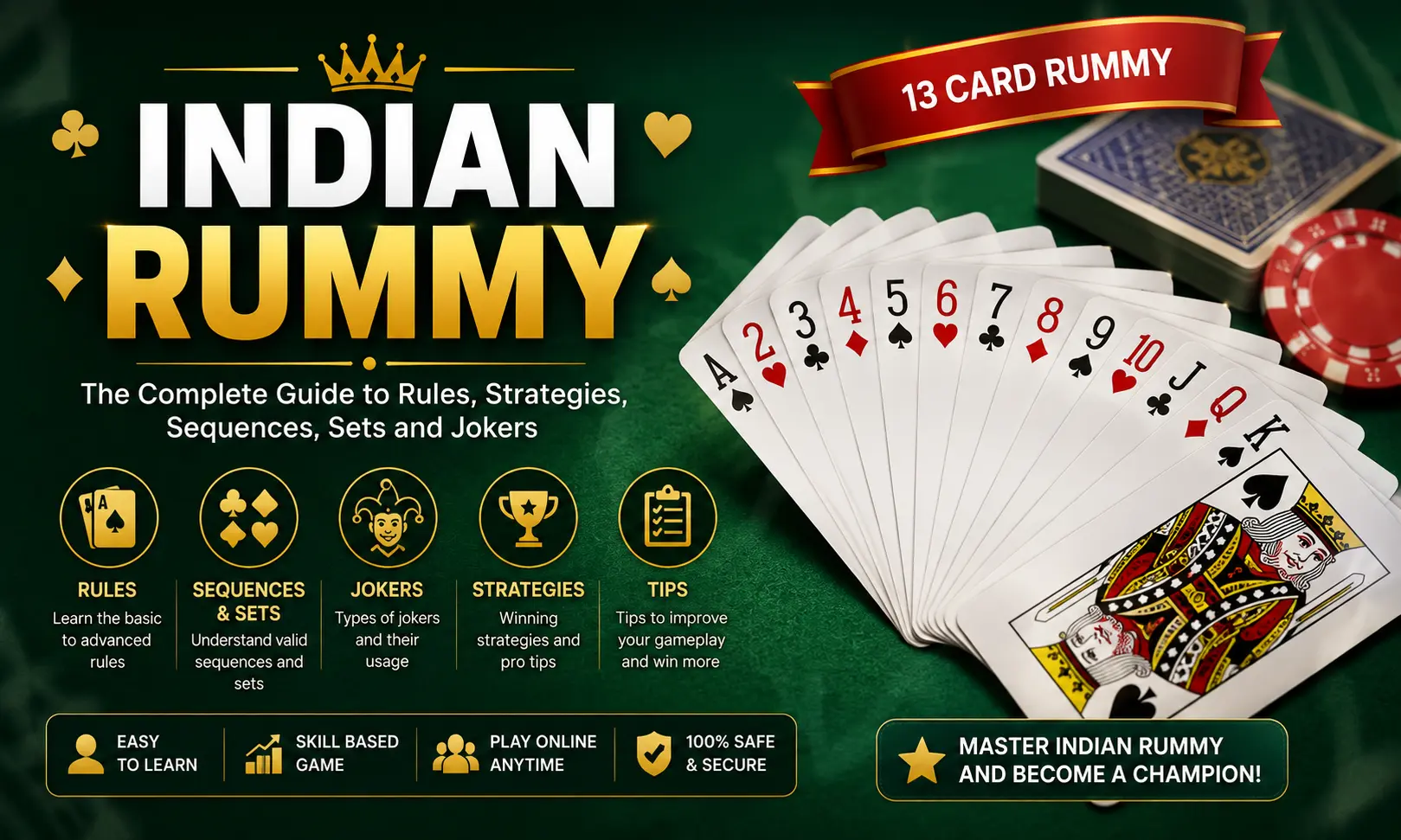
Indian Rummy is one of the most recognizable forms of rummy played in India. The game combines simple draw-and-discard mechanics with decision-making, observation, card arrangement, probability, and strategic planning. Although the basic idea is easy to understand, becoming comfortable with Indian Rummy requires a clear understanding of sequences, sets, jokers, declarations, scoring, and common mistakes.
This complete Indian Rummy guide is designed as pillar content for anyone who wants to understand the game from the ground up. Instead of covering only one aspect of the game, it brings the major topics together in one place, including Indian Rummy rules, 13 Card Rummy, pure sequence, impure sequence, sets, jokers, gameplay, scoring, strategies, mistakes, online play, and responsible gaming.
Important: Rummy formats and scoring systems can vary between platforms. Always check the rules of the particular table or platform before starting a game. This guide explains the commonly used structure of 13-card Indian Rummy.
Table of Contents
- What Is Indian Rummy?
- Why Is Indian Rummy So Popular?
- Understanding 13 Card Indian Rummy
- Objective of Indian Rummy
- Indian Rummy Cards and Players
- How to Set Up an Indian Rummy Game
- How to Play Indian Rummy Step by Step
- Understanding Rummy Sequences
- What Is a Pure Sequence?
- What Is an Impure Sequence?
- Understanding Rummy Sets
- How Jokers Work in Indian Rummy
- What Is a Valid Declaration?
- Invalid Declaration in Indian Rummy
- Indian Rummy Scoring
- Points Rummy
- Pool Rummy
- Deals Rummy
- Indian Rummy Strategy for Beginners
- Advanced Indian Rummy Strategy
- How to Choose Cards During a Turn
- Understanding the Discard Pile
- Common Indian Rummy Mistakes
- How to Improve Your Rummy Skills
- Indian Rummy Online
- Safety Tips for Online Rummy
- Responsible Gaming
- Indian Rummy Terminology
- Frequently Asked Questions
- Conclusion
1. What Is Indian Rummy?
Indian Rummy is a popular variation of the traditional rummy family of card games. The commonly played 13-card version gives each player 13 cards, with the objective of arranging those cards into valid combinations before making a declaration.
The central concepts are sequences and sets.
A sequence is generally formed by arranging consecutive cards of the same suit. A set consists of cards having the same rank but belonging to different suits.
A typical winning arrangement requires at least two sequences, including at least one pure sequence, while the remaining cards must also be arranged into valid groups.
For example, a player might arrange 13 cards into:
- One pure sequence
- One additional sequence
- One set
- Another set
The exact arrangement depends on the cards received and the rules of the particular format.
Indian Rummy is therefore not simply about receiving good cards. Players need to continually evaluate their hand, choose useful cards, discard unnecessary cards, and anticipate what opponents may be collecting.
2. Why Is Indian Rummy So Popular?
There are several reasons Indian Rummy has remained popular.
Easy Basic Concept
The fundamental gameplay is straightforward:
Draw a card → organize your hand → discard a card → continue building combinations.
This makes the game approachable for beginners.
Strategic Depth
Although the basic mechanics are simple, every draw and discard can affect the outcome.
Players must consider:
- Which cards are useful?
- Which cards should be discarded?
- What sequence can be completed?
- Which cards might an opponent need?
- Should a joker be saved?
- Is the hand ready for declaration?
This creates considerable strategic depth.
Different Game Formats
Indian Rummy can be played in formats such as:
- Points Rummy
- Pool Rummy
- Deals Rummy
The core arrangement concepts remain similar, but scoring and match structure can differ.
3. Understanding 13 Card Indian Rummy
The term 13 Card Rummy refers to the common Indian Rummy format in which each player receives 13 cards.
The basic objective is to organize those cards into valid combinations.
A typical structure requires:
- At least two sequences
- At least one pure sequence
- Remaining cards arranged into valid sequences or sets
The pure-sequence requirement is especially important because players sometimes create several attractive combinations but forget to build a pure sequence.
A hand that does not satisfy the required declaration conditions can be invalid even when most of the cards appear organized.
4. Objective of Indian Rummy
The primary objective is to arrange your complete hand into valid combinations and make a correct declaration.
The game revolves around reducing unmatched cards while building the combinations needed for a valid finish.
Suppose you receive:
5♥ 6♥ 7♥
These cards already create a pure sequence.
Now imagine you have:
9♣ 9♦ 9♠
These can form a set.
Your remaining cards must then be arranged into additional valid groups.
The key is not merely to create combinations but to create the right combination structure for a valid declaration.
5. Indian Rummy Cards and Players
The exact deck configuration can depend on the number of players and the platform or house rules.
Common 13-card Indian Rummy games use standard playing cards and jokers. Each player receives 13 cards, while the remaining cards form the draw pile and a discard pile is maintained during play.
The four traditional suits are:
- Hearts
- Diamonds
- Clubs
- Spades
Cards generally include:
- Ace
- 2 through 10
- Jack
- Queen
- King
Jokers may also be included and can play an important role in completing combinations.
6. How to Set Up an Indian Rummy Game
A basic game follows this general process.
Step 1: Shuffle the Cards
The cards are shuffled before dealing.
Step 2: Deal the Cards
Each player receives 13 cards.
Step 3: Create the Draw Pile
The remaining cards form the closed or draw pile.
Step 4: Create the Discard Pile
A card is placed face up to begin the open or discard pile.
Step 5: Select a Joker
Depending on the rules, a card may be selected to determine the wild joker for that round.
The exact joker mechanism can vary by platform.
7. How to Play Indian Rummy Step by Step
Indian Rummy follows a repeated draw-and-discard cycle.
Step 1: Observe Your Cards
Start by sorting your cards according to:
- Suit
- Rank
- Possible sequences
- Possible sets
- Potential joker combinations
Do not immediately discard cards without understanding the overall structure of your hand.
Step 2: Identify Potential Sequences
Look for consecutive cards belonging to the same suit.
For example:
4♠ 5♠ 6♠
is a natural sequence.
Similarly:
9♥ 10♥ J♥
forms a sequence.
Step 3: Identify Potential Sets
Look for cards having the same rank.
For example:
8♣ 8♥ 8♦
can form a set under common rules.
Step 4: Draw a Card
During your turn, you normally choose between the available closed/draw pile and the visible discard pile.
Step 5: Reorganize Your Hand
After drawing, reconsider your combinations.
A newly drawn card may:
- Complete a sequence
- Improve a set
- Create a new possibility
- Become useful later
Step 6: Discard a Card
After drawing, discard one card according to the applicable rules.
The objective is to gradually transform your hand into valid combinations.
8. Understanding Rummy Sequences
Sequences are one of the most important concepts in Indian Rummy.
A sequence generally consists of consecutive cards belonging to the same suit.
For example:
3♦ 4♦ 5♦
is a sequence.
Another example:
10♣ J♣ Q♣
is also a sequence.
Sequences are commonly divided into two major categories:
- Pure Sequence
- Impure Sequence
Understanding the difference between these two is essential for beginners.
9. What Is a Pure Sequence?
A pure sequence is a sequence of consecutive cards from the same suit without using a joker as a substitute for another card.
Examples include:
5♥ 6♥ 7♥
and
9♠ 10♠ J♠ Q♠
These are natural consecutive sequences.
The pure sequence is particularly important because a valid declaration commonly requires at least one such sequence.
Why Is a Pure Sequence Important?
Many beginners focus on making sets because they appear easy to create.
However, a hand full of sets is not necessarily a valid winning hand.
A player should therefore identify a potential pure sequence early in the game.
Practical Tip
When you receive your cards, first look for:
three consecutive cards of the same suit.
If you already have one, you have a strong foundation for organizing the rest of the hand.
10. What Is an Impure Sequence?
An impure sequence is a sequence in which a joker substitutes for a missing card.
For example, suppose you have:
6♥ 7♥ Joker
The joker can potentially represent the missing 8♥ under common rules.
This allows players to complete combinations that would otherwise be difficult.
However, players should not assume that every joker combination automatically satisfies the pure-sequence requirement.
The distinction between natural cards and joker substitutions matters.
11. Understanding Rummy Sets
A set usually consists of cards with the same rank but different suits.
For example:
7♠ 7♥ 7♦
can form a set.
Another example is:
K♣ K♦ K♥
A set is different from a sequence because the cards do not have to be consecutive.
Instead, they share the same rank.
Sequence vs Set
| Feature | Sequence | Set |
|---|---|---|
| Main characteristic | Consecutive cards | Same rank |
| Same suit required | Usually yes | No |
| Example | 4♥ 5♥ 6♥ | 8♣ 8♦ 8♠ |
| Joker possible | Depending on format | Depending on format |
| Strategic role | Essential for declarations | Helps organize remaining cards |
A common beginner mistake is confusing a group of same-rank cards with a sequence.
12. How Jokers Work in Indian Rummy
Jokers can dramatically change the possibilities in a hand.
There may be:
- Printed jokers
- Wild jokers
The exact mechanics depend on the game rules.
A joker can often substitute for a missing card in an impure sequence or set.
For example:
8♣ 9♣ Joker
may represent:
8♣ 9♣ 10♣
if the applicable rules permit that substitution.
Should You Keep Every Joker?
Not necessarily.
Jokers are valuable, but their value depends on your overall hand.
A joker may be particularly useful when:
- You are one card away from completing a combination.
- It helps convert multiple cards into valid groups.
- You need flexibility to complete your final arrangement.
However, the best use of a joker depends on the particular cards in your hand.
13. What Is a Valid Declaration?
A declaration is the point at which a player announces that their cards have been arranged according to the required rules.
Before declaring, carefully verify every group.
A common structure is:
- One pure sequence
- One additional sequence
- Remaining valid sequences and/or sets
The exact declaration requirements can vary according to the specific platform or variant.
Declaration Checklist
Before declaring, ask:
- Do I have a pure sequence?
- Do I have the required second sequence?
- Are all remaining cards grouped correctly?
- Have I accidentally used a card twice?
- Are all joker substitutions valid?
- Does the selected table use any special declaration rules?
Taking a few seconds to verify the hand can prevent an invalid declaration.
14. Invalid Declaration in Indian Rummy
An invalid declaration occurs when the player’s cards do not satisfy the applicable winning conditions.
Common reasons include:
No Pure Sequence
The player may have sets and an impure sequence but no required pure sequence.
Incorrect Sequence
Cards may look similar but fail to form consecutive cards of the same suit.
Incorrect Set
Cards may have the same rank but contain an invalid combination under the applicable rules.
Unmatched Cards
One or more cards may remain outside valid groups.
Incorrect Joker Usage
A joker may have been placed where the particular rules do not allow it.
Therefore, always verify the complete hand before declaring.
15. Indian Rummy Scoring
Scoring depends on the format.
In many points-based systems, cards that remain unmatched contribute points to the player’s score, while a successful declaration ends the hand.
High-value cards generally deserve careful attention because keeping unnecessary high-value cards can increase potential losses when a round ends.
Typical high-value cards include:
- King
- Queen
- Jack
- 10
Aces may also have a value defined by the particular rules.
Always check the scoring table of the game you are playing.
16. Points Rummy
Points Rummy is generally structured around individual hands.
The value of the hand is determined using the applicable point system, and the winner of the round is decided according to the rules.
The major attraction of this format is its relatively straightforward structure.
A player can concentrate on:
- Building valid combinations
- Reducing points
- Making a correct declaration
- Managing each hand efficiently
Because a round can end quickly, decision-making speed becomes important.
17. Pool Rummy
Pool Rummy is generally played across multiple rounds until a player reaches the specified elimination threshold.
Players try to keep their accumulated score as low as possible.
Depending on the variant, players may encounter formats such as:
- 101 Pool
- 201 Pool
The exact rules can vary.
Pool Rummy therefore requires greater attention to long-term score management.
A player who suffers a bad round may still have opportunities to recover in later rounds.
18. Deals Rummy
Deals Rummy generally gives players a predefined number of chips or points and plays across an agreed number of deals.
The player with the strongest overall result at the end of the deals wins according to the specific rules.
Compared with a single-hand format, Deals Rummy places greater emphasis on maintaining consistency.
19. Indian Rummy Strategy for Beginners
Beginners should focus on understanding the structure of the game rather than trying to memorize complicated tricks.
Strategy 1: Build a Pure Sequence Early
Your first major priority should be finding a possible pure sequence.
Once you have one, your remaining cards become easier to organize.
Strategy 2: Sort Your Cards
Arrange cards by suit.
For example:
Hearts: 4, 5, 8, 9
Spades: 2, 3, 4, 10
Diamonds: 6, 6
Clubs: 9, J, Q
This makes potential combinations easier to identify.
Strategy 3: Remove Unnecessary High Cards
If a high-value card does not appear to contribute to a useful combination, consider whether keeping it is worthwhile.
Holding disconnected high cards can create unnecessary risk.
Strategy 4: Watch the Discard Pile
The open pile provides information.
If an opponent repeatedly avoids certain cards, you may gain clues about what they are not collecting.
Likewise, if an opponent picks up a particular card, that can potentially indicate what kind of combination they are building.
Strategy 5: Do Not Chase Every Combination
A common mistake is trying to preserve every possible sequence.
Sometimes you need to abandon one combination to strengthen another.
20. Advanced Indian Rummy Strategy
Once you understand the fundamentals, you can begin thinking beyond your own cards.
Card Efficiency
Consider how many cards are required to complete a combination.
For example:
5♥ 6♥
has an immediate connection because either 4♥ or 7♥ could help.
By contrast:
2♣ 9♣
has a much wider gap and may be less immediately useful.
This does not mean disconnected cards are always bad, but they deserve closer evaluation.
Flexibility
Cards that can participate in multiple combinations are often valuable.
For example:
7♥ 8♥
can potentially connect to several neighboring cards.
A flexible hand gives you more options after each draw.
Opponent Awareness
Do not focus exclusively on building your own combinations.
Observe:
- What cards opponents pick
- What cards they discard
- Which suits appear repeatedly in the discard pile
- How quickly they reduce their visible options
This information can help you make better discard decisions.
21. How to Choose Cards During a Turn
Each turn presents a decision.
You can generally choose between:
Closed/Draw Pile
and
Open/Discard Pile
The open pile provides known information because you can see the card.
The closed pile provides uncertainty but may produce a card you need.
When the Open Card May Be Useful
Consider taking it when:
- It completes a sequence.
- It completes a set.
- It creates a strong combination.
- It significantly improves your hand.
When to Avoid It
Avoid taking a visible card merely because it looks interesting.
Every card you take can reveal information to opponents.
22. Understanding the Discard Pile
The discard pile is not simply a collection of unwanted cards.
It can be an information source.
Suppose you discard a 9♣ and your opponent immediately takes it.
That could indicate that the card has value to their hand.
You should not automatically assume their exact combination, but repeated patterns can provide useful clues.
Similarly, if several cards of a particular suit are discarded without being picked up, that may suggest that suit is less valuable to the opponents.
23. Common Indian Rummy Mistakes
Mistake 1: Declaring Too Early
A hand may look almost complete but still contain one invalid group.
Always check every card.
Mistake 2: Ignoring the Pure Sequence
This is one of the most damaging beginner mistakes.
A player may build several sets but fail to create the required pure sequence.
Mistake 3: Keeping High Cards Too Long
Disconnected high-value cards can become costly.
Mistake 4: Taking Every Useful-Looking Discard
Not every visible card deserves to be picked up.
Mistake 5: Ignoring Opponents
Rummy is not played in isolation.
Your opponents’ actions contain information.
Mistake 6: Holding Too Many Alternatives
Sometimes players maintain several half-completed combinations simultaneously.
This can make the hand inefficient.
Mistake 7: Playing Emotionally
A bad draw does not mean the game is lost.
Likewise, a strong opening hand does not guarantee victory.
24. How to Improve Your Rummy Skills
Improvement comes from understanding decisions rather than simply playing more hands.
Practice Card Recognition
Train yourself to quickly identify:
- Sequences
- Sets
- Potential sequences
- High-risk cards
- Joker opportunities
Review Your Decisions
After a round, ask:
- What was my first mistake?
- Which card should I have discarded?
- Did I recognize the pure sequence early?
- Did I reveal useful information to my opponent?
- Did I declare too soon?
Learn From Patterns
Over time, you will begin recognizing recurring situations.
For example, you may learn that holding too many disconnected high cards usually makes your hand harder to finish.
25. Indian Rummy Online
The growth of smartphones and internet connectivity has made card games accessible through digital platforms.
Online Indian Rummy can provide features such as:
- Digital card dealing
- Automatic score calculation
- Multiple game formats
- Practice tables
- Player matchmaking
- Game histories
- Tutorials
However, online platforms can have rules that differ from one another.
Before starting, check:
- Number of cards
- Number of players
- Joker rules
- Declaration requirements
- Scoring
- Drop rules
- Entry conditions
- Withdrawal policies, where applicable
Never assume that every online rummy platform uses exactly the same rules.
26. Safety Tips for Online Rummy
Players should take online safety seriously.
Use Reputable Platforms
Before creating an account, research the platform and understand who operates it.
Read the Rules
Do not rely only on promotional information.
Read the actual terms, game rules, and applicable policies.
Protect Your Account
Use:
- A strong password
- Two-factor authentication where available
- A secure email account
- Updated devices
Never share passwords or one-time authentication codes.
Check Local Laws
Online gaming laws and regulations can differ by jurisdiction and can change over time.
Before participating in any real-money activity, verify that the activity is legally available where you live and understand the platform’s eligibility requirements.
27. Responsible Gaming
Rummy should be approached as entertainment rather than a guaranteed way to make money.
For real-money formats, players should establish a budget before playing and never use money required for essential expenses.
Useful principles include:
- Set a spending limit.
- Set a time limit.
- Never chase losses.
- Take breaks.
- Do not borrow money to play.
- Stop when the activity is no longer enjoyable.
- Follow the platform’s age and eligibility requirements.
If you notice that gaming is becoming difficult to control, consider stopping and seeking appropriate support.
28. Indian Rummy Terminology
Understanding terminology makes learning easier.
Pure Sequence
A natural sequence of consecutive cards of the same suit without a joker substituting for a missing card.
Impure Sequence
A sequence that uses a joker as a substitute, where permitted.
Set
Cards of the same rank arranged across different suits according to the applicable rules.
Joker
A card that can substitute for another card under the rules.
Draw Pile
The face-down pile from which players can draw.
Discard Pile
The face-up pile containing discarded cards.
Declaration
The action of announcing that your cards have been arranged into a valid winning hand.
Drop
Leaving a hand or round according to the rules of the specific format.
Points Rummy
A format where individual hands are generally settled using a point-value system.
Pool Rummy
A format in which cumulative scores are tracked across rounds.
Deals Rummy
A format involving a predefined number of deals and a chip/point structure.
29. Frequently Asked Questions About Indian Rummy
Indian Rummy is a popular rummy variant commonly played with 13 cards per player. The objective is to arrange the cards into valid sequences and sets and make a correct declaration.
The commonly played Indian Rummy format deals 13 cards to each player. The exact deck arrangement can vary depending on the number of players and the particular rules.
A pure sequence consists of consecutive cards belonging to the same suit without using a joker as a substitute for another card.
For example:
4♠ 5♠ 6♠
is a pure sequence.
A common 13-card Indian Rummy structure requires at least two sequences, including at least one pure sequence. However, players should always verify the rules of the particular platform or variant.
Yes, under common rules a joker can substitute for a missing card to create an impure sequence. It generally cannot simply be treated as making a pure sequence when it is being used as a substitute.
A set is a combination of cards with the same rank but different suits, subject to the specific game rules.
For example:
Q♠ Q♥ Q♦
can form a set.
After drawing a card, you normally reorganize your hand and discard one card. This maintains the required hand size and continues the draw-and-discard cycle.
The cards dealt are random, but the decisions made after receiving them involve strategy.
Players must decide:
Which cards to retain
Which cards to discard
When to change combinations
How to use jokers
How to interpret the discard pile
When to declare
Therefore, understanding the rules and making disciplined decisions are important parts of the game.
One of the biggest mistakes is forgetting the pure-sequence requirement.
A player can have several apparently good combinations and still have an invalid hand if the required declaration structure has not been achieved.
Safety depends on the platform and the player’s behavior.
Use reputable services, read their rules and terms, protect your account, verify eligibility and local legal requirements, and use responsible gaming limits when participating in real-money formats.
30. Indian Rummy: Practical Example
Let’s consider a simplified example.
Suppose your 13 cards contain:
4♥ 5♥ 6♥
This immediately gives you a pure sequence.
You also have:
9♣ 10♣
You now have the beginning of another sequence.
You receive:
J♣
Now you have:
9♣ 10♣ J♣
Your second sequence is complete.
Suppose your remaining cards include:
8♠ 8♦ 8♥
These can potentially create a set.
The remaining cards should then be arranged into another valid group.
This example demonstrates an important principle:
Do not judge cards individually. Judge how they work together.
A card that looks weak on its own may become extremely valuable when combined with another card.
31. How to Think About Every Card
A useful mental model for Indian Rummy is to classify each card into one of four categories:
Category 1: Completed Combination
The card already belongs to a valid sequence or set.
Category 2: Near Combination
The card is close to completing a combination.
Category 3: Flexible Card
The card can potentially participate in multiple combinations.
Category 4: Isolated Card
The card currently has little connection to the rest of the hand.
This classification helps simplify difficult decisions.
Instead of asking:
“Do I like this card?”
ask:
“What function does this card have in my final hand?”
That is a much more useful strategic question.
32. Indian Rummy and Probability
You do not need advanced mathematics to play Rummy effectively, but basic probability thinking can help.
Suppose you need one specific card to complete a sequence.
You should recognize that waiting for that exact card carries uncertainty.
Instead of relying completely on one possibility, look for flexible alternatives.
For example, if your hand can be completed by several possible cards, you have more paths toward a valid declaration than if you require one exact card.
This is why flexible combinations can be valuable.
33. Why Discarding Is as Important as Drawing
Many beginners focus heavily on the card they want to draw.
Experienced players also pay attention to the card they are going to discard.
Your discard can:
- Reduce your own deadwood.
- Reveal information.
- Potentially help an opponent.
- Remove a difficult card.
- Preserve flexibility.
Therefore, every turn should involve two questions:
What card should I take?
and
What card should I release?
Both decisions matter.
34. Building a Strong Indian Rummy Mindset
Good Rummy decisions usually come from patience and discipline.
Do not become attached to a combination simply because you have already invested several turns in it.
If a combination stops being useful, be willing to change it.
Likewise, do not assume that a joker must always be used immediately.
Sometimes keeping a flexible joker until the rest of the hand becomes clearer is more useful.
The objective is not to create the prettiest-looking hand.
The objective is to create a valid and efficient final hand.
35. Indian Rummy Content Strategy: Building a Pillar Page
For website owners targeting Indian Rummy, this article can serve as the main pillar page.
The main page should target:
Primary Keyword: Indian Rummy
Then create supporting cluster articles around closely related search intents.
Suggested Cluster Articles
- Indian Rummy Rules
- How to Play Indian Rummy
- 13 Card Rummy Rules
- Indian Rummy Sequences
- Pure Sequence in Rummy
- Impure Sequence in Rummy
- Rummy Sets
- Rummy Joker Rules
- Rummy Declaration Rules
- Rummy Scoring
- Points Rummy
- Pool Rummy
- Deals Rummy
- Indian Rummy Strategy
- Rummy Tips for Beginners
- Common Rummy Mistakes
- Rummy Card Values
- How to Arrange Rummy Cards
- Rummy Probability and Strategy
- Online Indian Rummy Guide
The pillar article should link naturally to these supporting articles when those pages exist.
This creates a topical structure in which the main Indian Rummy page acts as the central resource and cluster pages provide deeper information about individual subtopics.
36. Suggested Internal Linking Structure
A strong internal-linking structure could look like this:
Indian Rummy Pillar Page
↓
Indian Rummy Rules
↓
13 Card Rummy
↓
Pure Sequence
↓
Impure Sequence
↓
Rummy Sets
↓
Rummy Jokers
↓
Rummy Strategy
↓
Rummy Scoring
↓
Points Rummy
↓
Pool Rummy
↓
Deals Rummy
Each supporting article should link back to the main Indian Rummy pillar page using natural anchor text.
For example:
Learn more about the complete Indian Rummy rules before exploring advanced strategies.
Avoid inserting the same exact anchor repeatedly in every paragraph. Internal links should help readers navigate logically between related topics.
37. Recommended Keyword Cluster for Indian Rummy
Instead of repeatedly using only the exact keyword Indian Rummy, build a semantic keyword group.
Primary Keyword
- Indian Rummy
Secondary Keywords
- Indian Rummy game
- Indian Rummy rules
- Indian Rummy cards
- Indian Rummy strategy
- Indian Rummy tips
- 13 Card Rummy
- Indian card game
- Rummy sequences
- Rummy sets
- Rummy joker
- Rummy declaration
Long-Tail Keywords
- how to play Indian Rummy
- Indian Rummy rules for beginners
- how many cards in Indian Rummy
- what is a pure sequence in Rummy
- what is an impure sequence in Rummy
- how to make a valid Rummy declaration
- Indian Rummy strategy for beginners
- how does joker work in Indian Rummy
- difference between sequence and set in Rummy
- complete 13 Card Rummy guide
Use these terms naturally according to the section being discussed rather than forcing every keyword into every paragraph.
38. How to Make This Pillar Article Stronger
A pillar page should be more useful than a collection of keywords.
Consider adding:
- Original examples
- Card arrangement diagrams
- Clear tables
- Author information
- Updated rules
- Links to supporting articles
- Frequently asked questions
- Responsible gaming information
- Platform-specific rules where appropriate
- References to authoritative sources
Google’s guidance emphasizes original value, comprehensive coverage, clear authorship, accuracy, and content created primarily to help people.
Therefore, simply making the article longer is not enough.
The goal should be to make it the page a reader would bookmark when learning Indian Rummy.
39. Final Indian Rummy Checklist
Before publishing an Indian Rummy guide, check the following:
Content
- Clear introduction
- Definition of Indian Rummy
- 13-card explanation
- Objective
- Rules
- Pure sequence
- Impure sequence
- Sets
- Jokers
- Declaration
- Scoring
- Strategies
- Common mistakes
- FAQs
- Responsible gaming
SEO
- Primary keyword: Indian Rummy
- Related keywords included naturally
- Descriptive title
- Helpful headings
- Short readable paragraphs
- Internal links
- Relevant external references
- Descriptive image alt text
- Mobile-friendly layout
- Fast page experience
Pillar Content
- Main topic covered comprehensively
- Cluster topics identified
- Supporting articles planned
- Internal linking structure planned
- No keyword stuffing
- No unnecessary repetition
- Original examples included
- Content updated when rules change
Conclusion
Indian Rummy is a game that combines straightforward rules with increasingly sophisticated decision-making. The basic mechanics are easy to learn: receive your cards, draw and discard, build sequences and sets, and make a valid declaration. However, understanding the difference between pure and impure sequences, using jokers intelligently, managing high-value cards, observing the discard pile, and recognizing when to change your strategy can significantly improve your understanding of the game.
For beginners, the best starting point is to master the fundamentals. Learn how sequences work, understand sets, remember the importance of a pure sequence, and practice organizing 13 cards efficiently.
As your knowledge develops, move toward more advanced concepts such as card flexibility, opponent observation, discard management, probability, and hand optimization.
For website owners, this topic also works particularly well as pillar content. The main Indian Rummy page can serve as the central resource, while separate supporting pages can cover rules, 13 Card Rummy, sequences, sets, jokers, scoring, strategies, and different formats. Linking these pages together creates a logical topical structure and gives readers a clear path from basic information to advanced topics.
Most importantly, the goal of an Indian Rummy guide should not be to repeat keywords. It should answer the questions a real reader has before, during, and after learning the game. A comprehensive, accurate, well-organized resource is more valuable than a page created simply to reach a particular word count.
If playing online for real money, always check the applicable rules, eligibility requirements, platform terms, and local laws. Treat gaming responsibly, set limits, and never view it as guaranteed income.
Indian Rummy becomes much easier to understand when you stop looking at individual cards and start looking at the complete hand. Learn the rules first, practice the combinations, observe the game, and make each decision with a clear purpose.
Leave a Reply